Guide
AEO vs SEO vs GEO: what a Shopify merchant actually needs in 2026
Three acronyms untangled, and why product discovery on Shopify specifically comes down to AEO.
Three acronyms, one confusing conversation. If you've been reading about how to get found by AI, you've probably run into SEO, GEO, and AEO used almost interchangeably, sometimes in the same sentence, sometimes by people selling three different products. They're related, but they're not the same thing, and if you sell products on Shopify, one of them matters more to you than the other two.
Let's untangle it without the jargon.
SEO: getting found by search engines
SEO, search engine optimization, is the one you already know. It's the decades-old practice of making your pages rank well on Google and Bing so a person searching "waterproof hiking backpack" clicks your link instead of a competitor's. It's built around keywords, backlinks, page speed, domain authority, and a search results page full of blue links a human scrolls through.
SEO still matters. People still type things into Google. But SEO was built for a world where the thing reading your page and the thing deciding whether to show it to someone were, more or less, the same search engine, and a human was always going to be the one clicking through and deciding what to buy.
GEO: getting cited inside AI-generated answers
GEO, generative engine optimization, is newer and broader. It's about how you show up when someone asks a chatbot a general question and the AI generates a written answer that might cite or mention your brand somewhere in the middle of it. Think "what's the best CRM for a small agency" answered as a paragraph with a few brand names woven in, not a page of links.
GEO is mostly about being cited as a source or an authority in AI-generated content generally, across any topic. It's a real and growing field, and it's not specific to e-commerce or to any one platform.
AEO: getting recommended for a specific purchase
AEO, answer engine optimization, is the one that matters most if you run a store. It's the practice of making sure an AI shopping agent (ChatGPT shopping, Claude, Perplexity, the assistants built into browsers and platforms) has enough structured, specific information about your actual products to recommend one of them by name when someone's trying to decide what to buy.
This is a narrower, more commercial question than GEO. Nobody needs your product cited as a general authority on backpacks. They need the AI to say, specifically, "get this one," when someone's about to spend money. That's a different job, and it needs different inputs: not backlinks, not domain authority, but structured product-level content an AI agent can actually read in the few seconds it spends deciding what to surface.
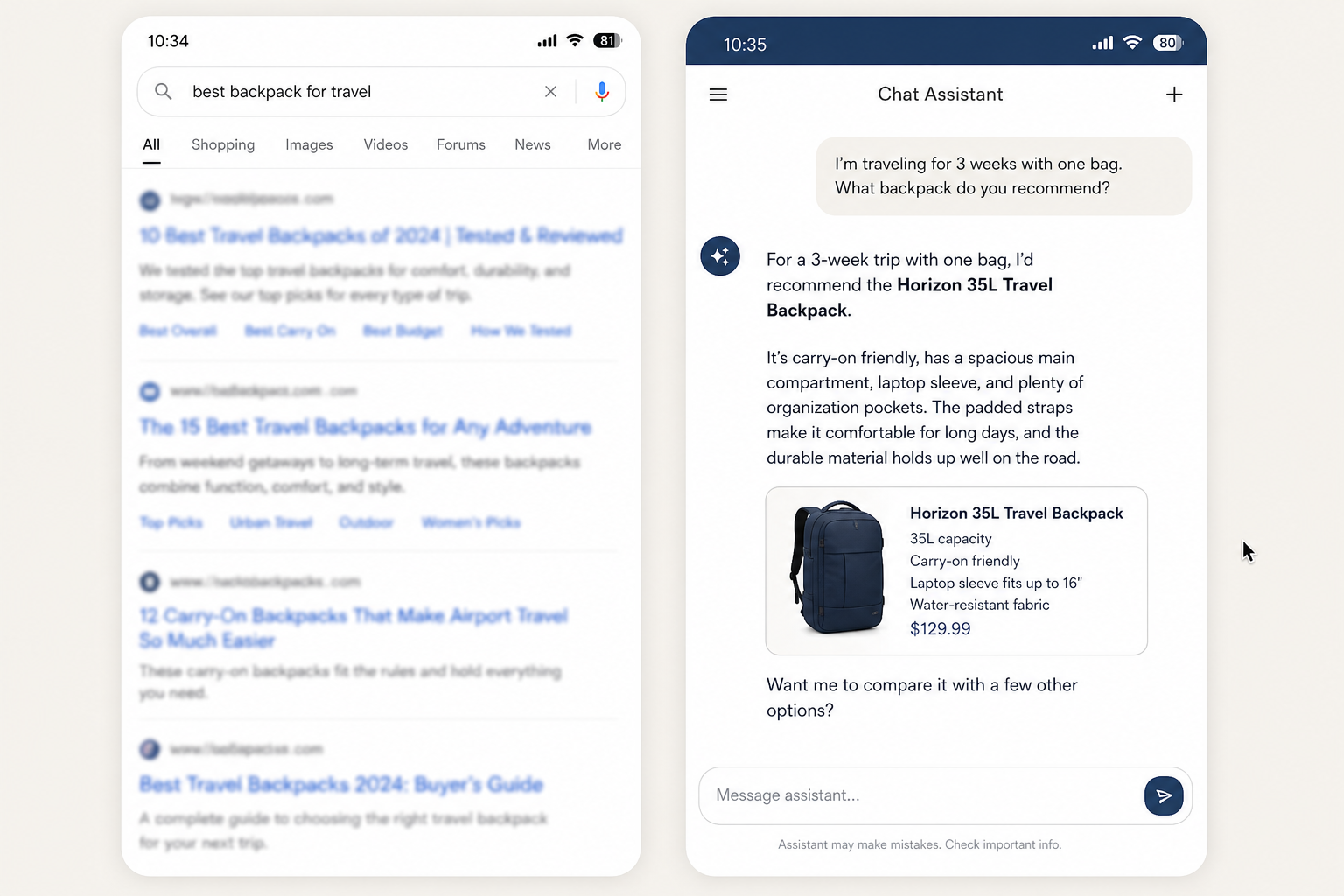
Why AEO is the one that matters for a Shopify store specifically
Here's the shift that makes this worth thinking about now instead of later: AI-driven orders have grown 15 times over since January 2025, and AI traffic to stores has grown roughly 8 times year over year, by Shopify's own reported numbers. McKinsey estimates agentic commerce, purchases made or assisted by AI agents, could be worth $3 to 5 trillion by 2030. That's not a niche channel anymore. It's becoming a real acquisition path, and it runs on a completely different mechanism than a search results page.
Shopify has actually built serious infrastructure for this already: a /llms.txt file with commerce protocol details, MCP tools for search and checkout, an agent flow, all live on every store by default. That's the plumbing that lets an AI agent complete a transaction once it's decided to. What it doesn't include is the part that gets a product chosen in the first place: descriptions, FAQ answers, the kind of specific reasoning a shopper (or their AI agent) needs to pick one backpack over another. We go deeper on that exact gap in why Shopify's own llms.txt isn't enough.
So where SEO gets you found in search results and GEO gets you cited in general AI-written content, AEO is the one that determines whether an AI shopping agent actually says your product's name when someone's ready to buy. For a Shopify store, that's the layer with the most direct line to revenue.
What this means practically
You don't need to abandon SEO. It still brings people to your store the old-fashioned way, and it isn't going anywhere. But if your product pages have nothing more than a title, a price, and whatever HTML description came out of a supplier feed, you're invisible to the part of the funnel that's growing fastest. AEO is the layer that needs real, specific, product-level content, not a rewritten meta tag.
This is exactly the gap OtoRank was built to close: an AEO score for every product in your catalog, AI-drafted descriptions and FAQs you review before anything publishes, and a /llms.txt file that actually gives AI shopping agents a reason to recommend what you sell, not just a way to check out once they've decided to. If you want to see where your own catalog stands on this, we're glad to book a short call and walk through it together, no pitch required.
Check your own store's AEO score
No login, no email, just a score and what to fix first.