Guide
Collection Catalogs and Why AI Agents Need Them Structured
Structured collection catalogs are the backbone of Shopify store visibility in AI-powered answer engines. Discover how clear, machine-readable grouping gets your products surfaced—and avoids being overlooked by AI agents.
What Are Collection Catalogs and Why Do They Matter?
Shopify merchants spend hours curating products into collections—carefully grouping items by type, theme, or promotion. But in the age of AI-powered answer engines, these internal catalogs are more than just “nice to have.” They’re a foundational bridge between your store and the new class of AI agents, voice assistants, and automated shopping tools. When your collection structure is clear and well-communicated, AI agents can accurately interpret, recommend, and surface your products to shoppers wherever those shoppers are searching—even beyond search engines, across chatbots, digital assistants, and beyond.
But if your catalogs are a tangle of inconsistent naming, missing hierarchy, or incomplete metadata, answer engines struggle. The outcome? Your store is left out of rich, conversational results—exactly the space where shopping intent is strongest and competition shrinking.
The Shift: From Browsing to Direct Answers
Let’s quickly recap why AI engines need a different approach compared to classic web crawlers. Traditional search engines indexed your product listings and hoped to match queries. Newer Large Language Model (LLM) agents want to understand your store conceptually: What kinds of products do you sell? How are they organized? What are the bestsellers in a category? To deliver direct answers—like “Find me eco-friendly water bottles on Shopify stores” or “Show me this week’s top dresses under $100”—AI systems rely on clear signals about your collections, not just product pages alone.
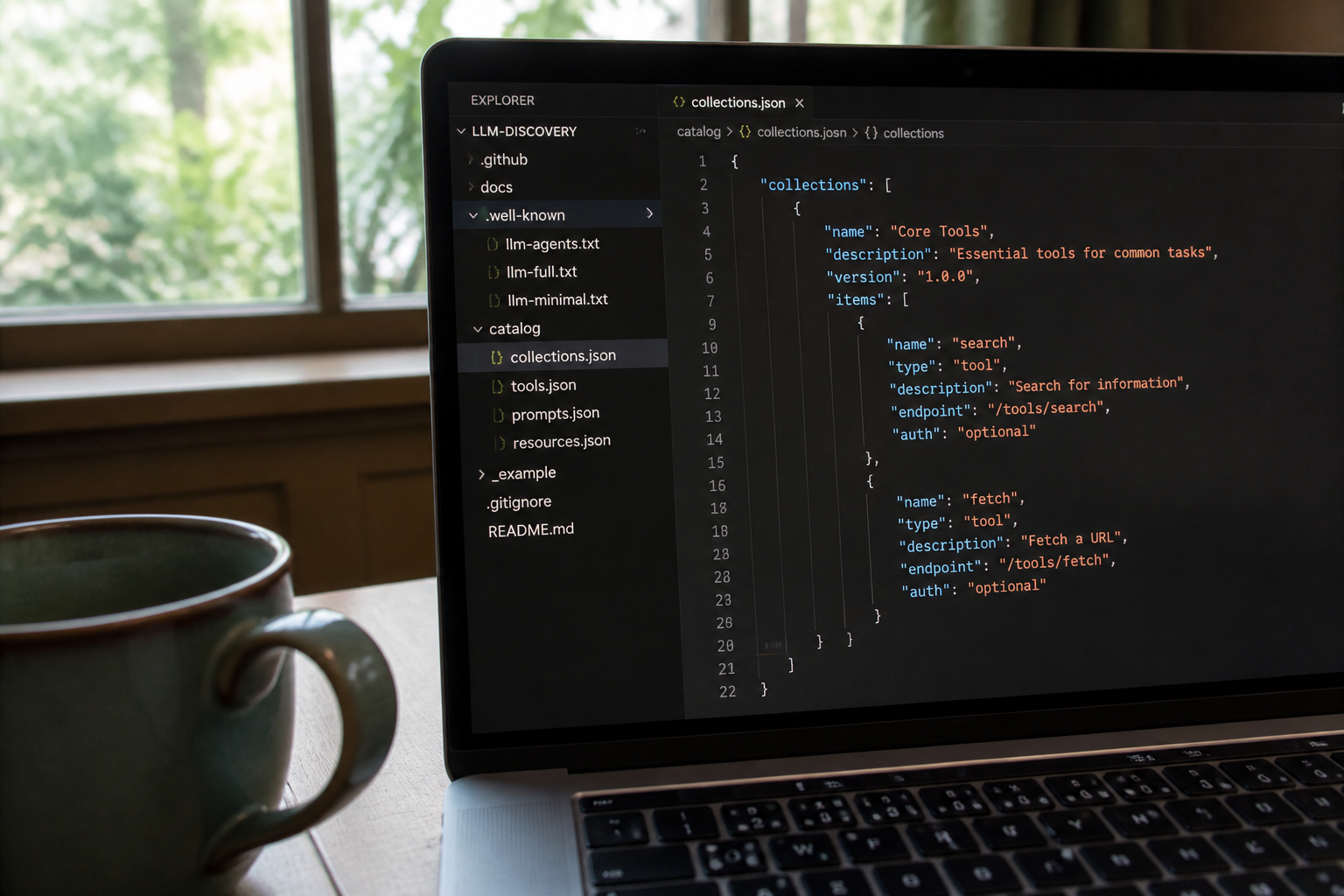
That’s why a structured collection catalog isn’t background admin work anymore; it’s a front-line AEO (Answer Engine Optimization) must-have for every Shopify brand. If you’re not sure where LLM engines pull this data from, you’ll want to read our LLM Discovery Files hub as a primer—these are the files and feeds that let AI systems scan and understand your store at scale.
What Does “Structured” Actually Mean?
When we say a collection catalog must be "structured," we mean its information is machine-readable, logically organized, and consistent. Structure isn’t about how your collections look on the Shopify frontend—it’s about their digital footprint for external systems. Here’s what matters most:
- Hierarchy: Are collections logically nested? E.g., “Clothing > Dresses > Summer Dresses” rather than dozens of flat, ambiguous groupings.
- Naming conventions: Collection handles and titles should be human-friendly but also clear about their contents (no jargon only you understand).
- Canonical mapping: Wherever possible, collections should map to standard e-commerce terms or verticals that AI models know—think "Tops,” "Electronics,” or "Kitchen & Dining.”
- Rich metadata: Each collection should include descriptions, cover images, featured attributes, and even price/brand ranges if possible. Adding structured data directly to metafields is rapidly becoming best practice. If unfamiliar, check out Metafields 101: Where AI-Ready Data Lives in Shopify.
- Product linking: Collections should be linked to up-to-date product SKUs; avoid stale or broken groupings that confuse AI crawlers.
Real-World Example: How AI Agents Use Catalog Structure
Imagine a user asking a voice assistant, “Can you find me vegan snacks from independent Shopify merchants?” If your collection is called “Plant-Based Delights,” but nowhere in the metadata or hierarchy does it mention ‘vegan’ or group with ‘snacks,’ AI agents may totally miss you. But if you have a collection titled “Vegan Snacks,” stored as an explicit node under “Food & Beverages,” with a rich metafield noting its dietary attributes and linked product count, you’re much more likely to appear in the answer set.
We see this in practice with OtoRank clients: stores using well-defined hierarchies and structured metafields in their collections show up far more often in recommended answers on leading chatbots, shopping assistants, and AI-driven product finders. Conversely, stores with flat or cryptically-named collections (“Sam’s Picks 2024”) are usually skipped, or their answers devolve into generic non-recommendations.
The LLM Discovery Files Angle: Making Your Collections Crawlable
The emerging industry standard for LLM discovery is to expose key details in a machine-friendly file or feed—commonly called llms.txt or, for more advanced use cases, llms-full.txt. These files act as guides for AI crawlers, outlining the structure and logic behind your store’s organization. For a deep dive, see llms-full.txt: When You Need the Deep Version, which explains how exposing more granular collection data can boost your performance in long-tail, intent-driven queries.
If your llms.txt (or product feeds) are incomplete or out of sync with your actual collections, you could actually tank your store’s visibility—even if your frontend looks great. Many merchants fall into classic traps, such as exposing redundant or conflicting collection names, or omitting nested groupings. To avoid these pitfalls, review Common llms.txt Mistakes That Confuse AI Crawlers.
Practical Steps to Structure Your Collections for AI Agents
- Audit your existing collection tree: Is there a logical hierarchy, and are groupings labeled with clear, widely-used terms?
- Add or enrich metafields: For each collection, add SKU counts, product types, popular filters, brand/category/price ranges, and a description in plain English.
- Map to industry standards: Align your collection groupings with global commerce taxonomies (Google Shopping categories, etc.).
- Expose your catalog in an LLM-friendly format: Use OtoRank or another tool to generate an up-to-date
llms.txtor similar file and check its accuracy regularly. - Test in AI environments: Use conversational AI (like ChatGPT or Google Assistant) to see what collections appear for related queries—iterate based on results!
Future-Proofing: Why You Can’t Ignore Structured Catalogs
As AI answer engines become the main way people find and shop for products, structured collection catalogs aren’t an optional SEO tweak—they’re the backbone of discoverability. Today’s investment in structure pays off with better AI coverage, broader reach on third-party platforms, and a future-ready foundation for whatever automated shopping arrives next.
Don’t settle for collections that only make sense to your internal team. Instead, view your catalog from an AI’s perspective: clear, richly described, and easy to traverse at scale. That’s how you get picked for the answers of tomorrow.
Frequently asked questions
Why do AI agents need collection catalogs to be structured?
Structured catalogs present clear, machine-readable information about how products are grouped, what categories exist, and what each collection contains. This allows AI agents to understand, recommend, and accurately surface your products when shoppers ask natural-language questions. Unstructured or inconsistent catalogs confuse these systems, reducing the chances your store will appear in relevant answers.
How do I make my Shopify collections structured for AI?
Ensure you use logical hierarchies, consistent naming, rich metadata (like metafields for descriptions and attributes), and expose your catalog using files like llms.txt, which are designed for AI crawlers. Mapping collection names to standard industry categories and updating these files regularly is also critical.
What is llms.txt and how does it relate to collection catalogs?
llms.txt is an emerging standard machine-readable file that exposes your product and collection structure for large language models. Including accurate and well-structured catalogs in this file helps AI agents discover all your groupings and serve your store’s content accurately in answers and recommendations.
Can poorly named or flat collections hurt my visibility in AI results?
Yes. Flat, ambiguous, or brand-specific collection names (like 'Sam’s Picks 2024') make it difficult for AI agents to match your products to user queries. Well-structured, clearly named collections with consistent metadata increase the likelihood your store is featured in AI-powered recommendations.
Where should I store structured collection data in Shopify?
Use metafields on collections to house structured data—like category tags, attributes, price ranges, and descriptions. This not only organizes your catalogs internally but also makes it easy to generate machine-friendly discovery files for AI agents.
Related reading
Check your own store's AEO score
No login, no email, just a score and what to fix first.