Guide
What is llms.txt, and why doesn't Shopify's version include your products?
llms.txt explained in plain English, and the real gap merchants don't know is there.
If you've never heard of llms.txt, you're not behind. Most merchants haven't. It's a fairly new idea: a plain text file that sits at a predictable URL on your store (yours is at yourstore.com/llms.txt right now, whether you've touched it or not) and gives AI systems a structured way to understand what your site is and how to work with it.
Think of it as the AI-era cousin of robots.txt. robots.txt tells search engine crawlers where they can and can't go. llms.txt tells AI agents (the kind powering ChatGPT shopping, Claude, Perplexity, and the shopping tools built on top of them) how your store works as a machine-readable document instead of a webpage full of buttons and images a bot has to guess at.
Here's the part that surprises most merchants: Shopify already generates this file for you. You didn't install anything. It's just there.
What's actually in Shopify's default llms.txt
Open your store's /llms.txt right now and you'll find something genuinely useful. It's not a placeholder or a stub. Shopify has built real infrastructure into it:
- A UCP (Universal Commerce Protocol) discovery endpoint
- MCP tool definitions like
search_catalog,create_cart, andcreate_checkout - An agent flow describing how to move from discovery to search to cart to checkout
- Store policy references
In other words, Shopify's file answers the question "how does an AI agent complete a purchase here?" It's protocol, not prose. It tells an AI assistant which levers to pull to search your catalog, add something to a cart, and check out. That's real, useful engineering, and it's live on every Shopify store by default.
What it does not answer is a different, earlier question: "what should I buy, and why?"
The part that's missing
Open the file and look for a description of your bestselling product. You won't find one. No FAQ answers. No comparison between your two similar SKUs. No paragraph explaining why your waterproof backpack is a better pick for a rainy commute than the one three tabs over. Shopify's /llms.txt and /llms-full.txt are, in practice, nearly identical documents: both are protocol manifests, and neither scales with how big or interesting your catalog is. A 20-product store and a 5,000-product store both get a file that's roughly the same handful of kilobytes, because it's describing capabilities, not products.
That's not a bug. It's not Shopify dropping the ball. Look at how the system is built: Shopify deliberately made /llms.txt overridable through their own templating system (templates/llms.txt.liquid), specifically so merchants and third parties can extend it with store-specific content. Meanwhile /.well-known/ucp, the actual commerce protocol endpoint, is intentionally not overridable. Shopify owns that layer on purpose. The content layer next to it was left open on purpose, too.
So the honest way to describe the situation is: Shopify built the checkout counter and handed you the keys to stock the shelves. Most merchants just haven't stocked them yet.
Why this matters more than it sounds like it should
Picture someone asking ChatGPT, "what's a good waterproof backpack under $80?" The AI assistant doesn't wander your site clicking around like a person would. It reads whatever machine-readable content it can find quickly, and it forms a recommendation from that. If the only thing available about your backpack is "exists, costs $79, ships in 3 business days," there's nothing for the AI to work with when it's deciding whether to say your product's name out loud to the shopper.
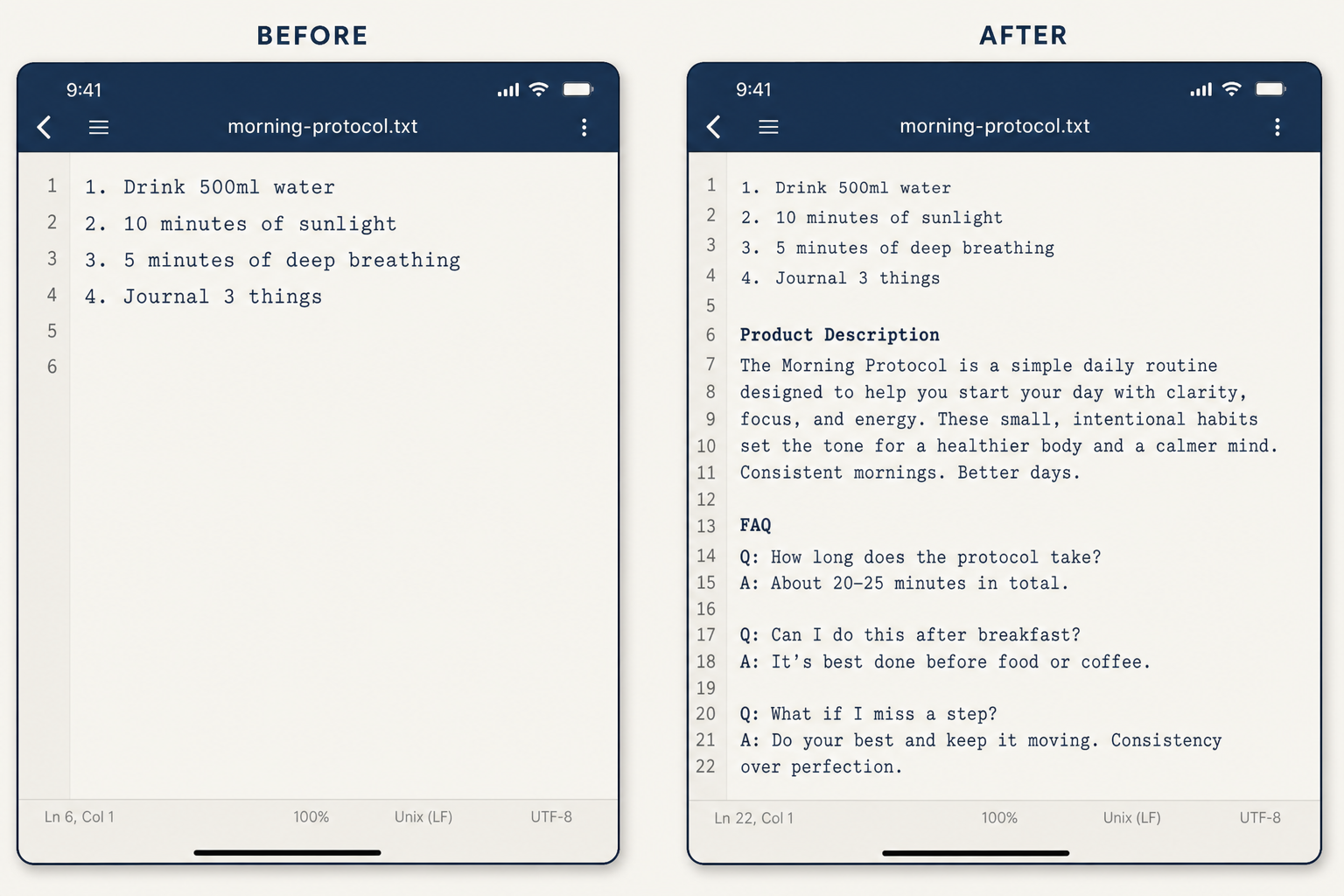
This is the gap OtoRank was built to close. We don't touch Shopify's protocol layer at all, that stays exactly as Shopify built it. We write into the same file, right after it, with the product descriptions, FAQ answers, and AEO-scored ordering that give an AI assistant an actual reason to recommend one product over another. One file, two jobs: Shopify handles how to buy, we handle what's worth buying.
If your catalog is on the larger side, there's a second, sneakier problem layered on top of this one: even once you have great product content, most AI crawlers can only read a few thousand tokens per document fetch. We dig into exactly what that means for a 5,000-product store in The 5,000-product problem.
What to actually do about it
You don't need to rebuild anything. Shopify's file isn't broken, and there's nothing to rip out. The move is simpler: add the layer that was always meant to sit alongside it. Product prose, FAQ pairs, and a sense of which of your products are actually ready to be recommended right now versus which ones still need attention.
If you want the fuller picture of how Shopify's four-layer approach to agentic commerce works, and exactly where the open gap is by Shopify's own admission, we walk through it in Why Shopify's own llms.txt isn't enough.
And if you're curious what your own store's file looks like right now, and whether it's giving AI shopping agents anything to work with, that's a five-minute check. We'd be glad to walk through it with you, no pressure, just a look at what's actually there. You can book a quick call whenever that's useful.
Check your own store's AEO score
No login, no email, just a score and what to fix first.