Guide
Avada vs. Booster: Comparing Two Shopify AEO Apps (and a Third Option)
How do Avada, Booster, and OtoRank stack up for Shopify answer engine optimization? Discover key AEO differences, strengths, and real-world considerations.
Introduction: Why Compare Avada and Booster for AEO?
For Shopify merchants, SEO is no longer just about Google rankings—answer engine optimization (AEO) is emerging as the new battleground. Apps promising to position your store for AI-driven answers (think: Google SGE, Bing Copilot, and Shopify Magic) abound, but two of the most prominent are Avada SEO Suite and Booster: AI SEO + AEO Optimizer. They’re everywhere in the Shopify App Store Positioning conversation, but when it comes to actionable AEO, how do they stack up? And is there a third option more purpose-built for AI answer engines? Let's compare how each approaches AEO in real, practical terms.
This article cuts through the marketing fluff, offering a concrete side-by-side of Avada and Booster (with OtoRank as a point of contrast), including candid feature breakdowns and real example scenarios. We'll also briefly cover why app positioning matters more than ever as Shopify's ecosystem grows.
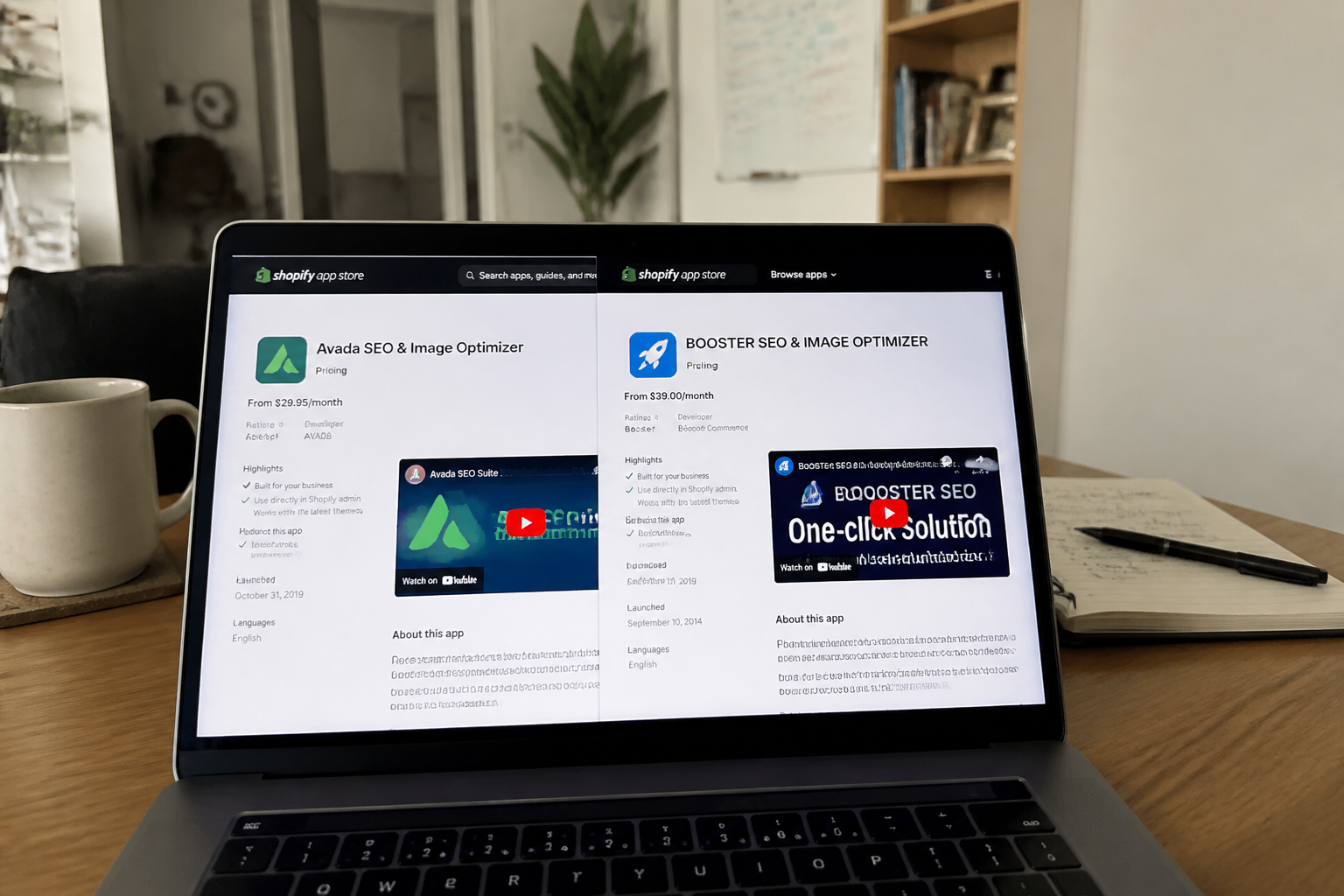
Avada SEO Suite: AEO by Association
Avada SEO Suite is one of the most popular SEO apps for Shopify. It claims features ranging from bulk meta edits and image optimization to structured data injectors. A recent update pitches their "AI SEO" and answer engine capabilities. But dig deeper, and you’ll find that Avada’s approach to AEO is mostly an evolution—and extension—of standard technical SEO:
- Structured Data: Avada offers JSON-LD enhancements for products and articles. While this is essential for answer box eligibility, it mostly conforms to old-school SEO requirements. Merchants must still manually ensure their content addresses likely user questions.
- AI-powered suggestions: Avada can recommend improvements and auto-generate some meta fields, but these suggestions are typically tuned for conventional SEO, such as keyword rankings, not AI answer intent.
- Lack of AEO-specific reporting: There’s little visibility into how your site or products perform in answer boxes, search generative experiences, or AI snippets. Users are left guessing whether tweaks actually improve AEO.
In short, Avada is great for cleaning up technical SEO, but AEO is more of a byproduct than a focus. This may suffice for merchants blending SEO and AEO organically, but those chasing specific answer engine results may hit a wall.
Booster: AI + AEO Optimizer — Promise vs. Practice
Booster has made waves as one of the few Shopify apps overtly marketing itself for AEO, as discussed in our in-depth look at the Booster AI SEO + AEO Optimizer Alternative. So how does it deliver?
- AI-generated content: Booster offers tools for creating product descriptions and FAQ answers in AI-friendly formats, aiming to increase the likelihood of your content being pulled into answer engines.
- Structured data tuning: The app automatically injects schema that highlights Q&As, reviews, and key product attributes—potentially boosting answer eligibility.
- AEO "Score": Booster provides an at-a-glance score for your pages’ readiness for answer engines. This often blends technical checks (like schema presence) with keyword targeting.
- Limited real-world feedback: Like Avada, Booster stops short of showing you actual, verifiable answer engine placements in Google SGE or Bing Copilot. It’s more about optimization potential than proven results.
For most merchants, Booster feels more purpose-built for AEO than Avada, with a UI and workflow making it easier to create the kind of content AI engines want. But as with all tools in this rapidly evolving space, "scores" are at best directional; there’s no substitute for watching your products appear in generative snapshots or voice answers in real searches.
A Third Option: OtoRank — Built From the Ground Up for Answer Engines
Unlike Avada (which adapts SEO for AEO) or Booster (which straddles both), OtoRank was designed for answer engine optimization from its inception. What does that look like in practice?
- AI answer engine simulations: OtoRank emulates how engines like Google SGE or Bing Copilot interpret your store's content, providing concrete suggestions—not just for ranking, but for being read aloud or cited in answer cards.
- Automated FAQ expansion: It identifies which customer questions are trending and auto-generates context-rich product or policy answers formatted to maximize SGE placement. This moves beyond basic schema, targeting answer extraction patterns used by real AI systems.
- Verifiable reporting: Merchants can see where and when their store is picked up by major answer engines, closing the gap between "optimization efforts" and actual outcome.
- Continuous AEO updates: OtoRank evolves its recommendations as new engines and answer formats appear—crucial since the AI landscape changes nearly monthly.
For a more direct comparison of OtoRank with other options, check out our recent breakdown of the 7 Best Shopify Apps for AI Engine Optimization (AEO) in 2026. Merchants who care about sustainable AEO results—especially as zero-click answers become the norm—often find this best-in-class focus results in more answer placements and less guesswork.
Shopify App Store Positioning Is Changing: What To Watch
Both Avada and Booster are aggressively shifting the narrative around AEO, responding to merchant demand and to Shopify App Store positioning dynamics. It's no longer enough for apps to promise "SEO"—savvy merchants demand verifiable results in emerging answer engines. The rise of purpose-built AEO apps like OtoRank both reflects and advances this trend.
For skeptics, Common Objections to AEO (and How to Answer Them) helps demystify these shifts, making it easier to explain to teams and stakeholders why AEO isn’t just another round of SEO window-dressing.
Conclusion: Which Should You Choose?
If you’re prioritizing old-school SEO hygiene with a side benefit of basic AEO, Avada offers a strong toolkit. Booster is best for shops seeking a bridge between traditional SEO and answer engine readiness, largely through structured content and scoring. But for those chasing real answer placements—read: featured as AI answers to customer queries—apps like OtoRank that specialize in AI engine optimization from the ground up are the clear front-runners.
The bottom line: As the Shopify ecosystem evolves, merchants must scrutinize what each app actually delivers for AEO. Don’t settle for claims—look for apps providing measurable results in the new search paradigm. That’s how you keep your store discoverable as answer engine optimization becomes standard practice.
Frequently asked questions
What is the difference between SEO and AEO on Shopify?
SEO (Search Engine Optimization) focuses on ranking your store's pages in search engines; AEO (Answer Engine Optimization) is about getting your content featured in AI-generated answer boxes and voice assistant results. While they overlap, AEO requires a different approach, emphasizing structured answers and verifiable data.
Does Avada really improve answer engine results, or just SEO?
Avada primarily boosts SEO, with some AEO features like structured data injection. However, its AEO improvements are largely indirect—there is little tracking or specialized reporting for answer engine placements.
How does Booster compare for answer engine optimization?
Booster offers more explicit AEO features, such as AI-friendly content generation and answer readiness scoring, but still lacks true verification of placements in answer engines. It's a step up from generic SEO tools but not as specialized as purpose-built AEO apps.
Why would I choose a dedicated AEO app like OtoRank?
OtoRank is designed from the ground up for answer engines, including simulation of AI engine behavior, automated FAQ expansion, and reporting on real answer placements. If direct answer visibility is your goal, a specialized AEO app makes it easier to achieve and measure results.
How can I learn more about positioning my app in the Shopify App Store for AEO?
For more insights, check out our detailed guide on <a href="/blog/shopify-app-store-positioning" class="text-brand-600 underline hover:text-brand-700">Shopify App Store Positioning</a> to understand current trends and actionable strategies.
Related reading
Check your own store's AEO score
No login, no email, just a score and what to fix first.