Guide
Free llms.txt Generators vs. Paid AEO Platforms: What You Actually Get
Free llms.txt generators offer basic compliance, but paid AEO platforms bring dynamic optimization for Shopify stores. Learn what each delivers—and what actually impacts your AI answer engine rankings.
The rise of generative AI in search—especially OpenAI’s plug-ins, Google's SGE, and other AI answer engines—has led to a surge of interest in llms.txt. This emerging standard, much like robots.txt for web crawlers, lets store owners communicate to language models which content can be used. Predictably, a host of free and paid tools have appeared that promise to help Shopify merchants generate and manage these files. But what do you actually get with a free llms.txt generator—and where do paid AEO (Answer Engine Optimization) platforms deliver real value?
Let’s dig into the capabilities (and limits) of both, explore what’s truly necessary for Shopify success, and dispel some of the hype around simplistic solutions.
What Does a Free llms.txt Generator Actually Do?
Most free llms.txt generators are simple tools—think form-based wizards or open-source scripts. You input your Shopify store’s URL, choose a few basic options (allow all, disallow all, specify certain paths), and with a click you get a file to upload to your server root. In under five minutes, your file is live and, in theory, you’ve sent LLMs a clear signal about your store’s content permissions.
- They’re simple: No sign-up, no ongoing cost, and no technical overhead.
- Many are open source or ad-supported, so there’s no commitment.
- They cover the absolute basics—just as a template robots.txt validator would for organic search.
The trouble is, that’s where these free tools stop. As AI ecosystem complexity grows, they address only a tiny fraction of what answer engines (and Shopify merchants) actually need.
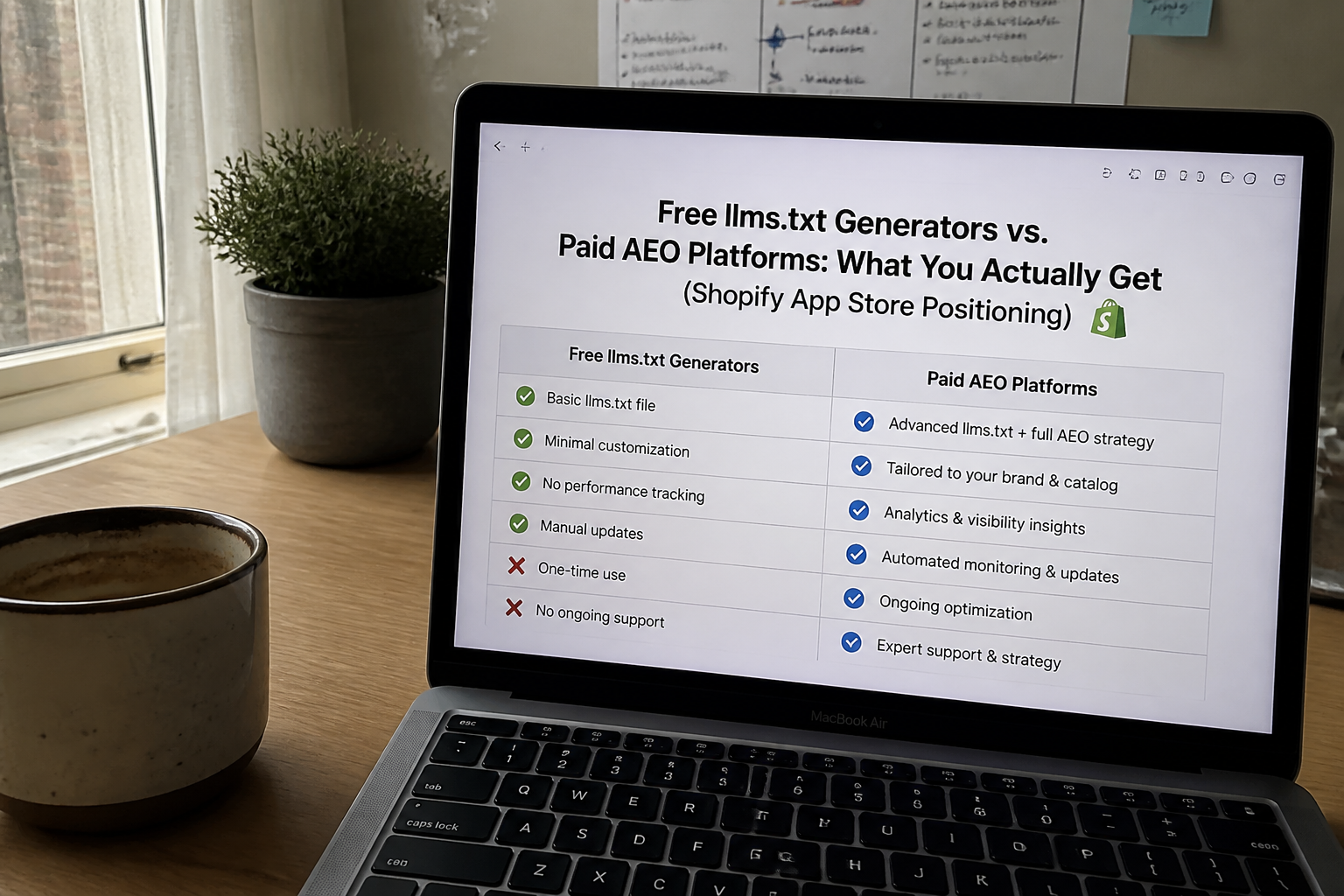
The Reality: llms.txt Alone Isn’t “Doing AEO”
Ask any optimization-savvy Shopify merchant: just uploading a llms.txt does little on its own. Language models—the audiences you want to reach—pull data from multiple sources, frequently reshape their crawling behaviors, and rarely consume signals as predictably as classic search crawlers. If your aim is to influence answer boxes, AI shopping guides, or product snippet rankings, a static file barely scratches the surface.
Think of llms.txt as table stakes. It signals intent. But it doesn’t organize your product catalog, optimize product copy for answerability, or keep up with evolving AI guidelines. As our deep-dive into AEO app selection criteria explains, today’s answer engines demand:
- Well-structured product data and schema markup
- Fresh, merchant-controlled AI-ready content
- Ongoing compliance tracking and error alerting
- Continuous adaptation as AI models and standards shift
No free generator is monitoring and updating your optimization edges—yet these edges are where modern Shopify positioning is won.
What Paid AEO Platforms Provide (That Free llms.txt Tools Don’t)
Let’s break down what you really get when you use a paid Shopify AEO platform versus a DIY file generator. Three concrete differentiators stand out:
- Automatic syncing with your Shopify store: Paid platforms connect directly to your live catalog and content feeds. As products, collections, or policy pages change, your
llms.txt(and associated structured data) update in real time. This prevents outdated signals from confusing answer engines. - Actionable diagnostics & audit trails: Need to know if your AEO setup is actually working—or if you’ve accidentally blocked valuable content? Good platforms surface warnings, show historical changes, and can even simulate LLM indexation so you see exactly what AI agents "see." A free tool simply generates a file and leaves you guessing.
- Integrated answer optimization capabilities: The best paid platforms aren’t just file generators. They help you optimize product descriptions, FAQs, and snippet structure for AI answer boxes, using data-informed recommendations or even AI-driven content enhancement. It’s AEO in practice, not just checkbox compliance.
In other words, while free systems cover static syntax, paid platforms bring living, merchant-tailored optimization—which is what truly impacts Shopify App Store Positioning and real-world visibility.
Examples of Real-World AEO Tradeoffs
Imagine two Shopify stores, both focused on DTC apparel. Store A uploads a static llms.txt once, using a free generator. Store B uses a paid AEO platform that synchs as new seasonal collections go live, flags duplicate SKUs, and creates AI-friendly FAQs tailored for current buyer questions.
A month later, OpenAI launches a new Shopping assistant model that deprecates certain schema fields and changes its preferred catalog structure. Store A’s file is now outdated and starts missing new product lines for LLM-powered discovery. Store B’s AEO platform catches the shift, updates content exposure automatically, and provides the merchant a tailored compliance checklist. Only Store B maintains prime visibility in new answer engine results.
For a Shopify merchant, this isn’t theoretical—it’s the new competitive reality in 2024.
Should Free llms.txt Tools Still Be Part of Your Stack?
Absolutely. A free llms.txt generator remains the fastest way to ensure you’ve got a basic file in place—especially if you’re launching a new Shopify store and aren’t ready for a paid commitment. It’s also handy for quick compliance checks or remediation between more sophisticated AEO audits.
But be honest about their limits. Merchant experience—proven in the trenches of Shopify App Store Positioning—shows that ongoing optimization drives results. For a buyer-centric comparison, see this in-depth buying checklist for AEO apps. Most merchants quickly graduate to paid platforms as answer engine competition intensifies.
It’s not just about file syntax. It’s about continual alignment with whatever—and wherever—AI answer engines surface your brand.
Key Takeaways
- Free llms.txt generators are a useful on-ramp, but offer only static, basic compliance (not optimization).
- Paid AEO platforms offer automated integration, issue monitoring, and real answer engine optimization—essential for sustainable Shopify visibility.
- Effective Shopify App Store Positioning requires ongoing AEO efforts, not just a one-time file upload. The gap between free and paid keeps growing as AI answer engines evolve.
Curious how top Shopify AEO apps deliver ongoing value? Explore our Shopify App Store Positioning hub and discover strategies for staying competitive as AI-powered discovery accelerates. And if you’re publishing AI-generated product content, don’t miss our guide to publishing AI content back to Shopify without breaking theme layout for practical deployment tips.
Frequently asked questions
Is a free llms.txt generator enough for Shopify stores to appear in AI answers?
No, a free generator ensures basic compliance but doesn’t optimize your content or adapt to changing AI standards. For meaningful visibility in AI answer engines, ongoing monitoring and answer optimization—functions of paid AEO platforms—are necessary.
How do paid AEO platforms improve upon a standalone llms.txt file?
Paid AEO platforms synchronize with your Shopify data, provide diagnostics, update files in real time, and spotlight actionable optimization opportunities, all of which are essential for maintaining visibility as answer engine expectations evolve.
Can I start with a free llms.txt tool and upgrade later?
Yes—free tools are a great quick-start, especially for new stores. However, as your store grows and competition for AI-powered visibility intensifies, most merchants transition to paid AEO solutions to avoid missed opportunities.
Do free generators provide error monitoring or adjustment recommendations?
No. Free generators typically just produce the file and offer no insight if it’s working or if answer engines’ requirements change. Monitoring and recommendations are features of paid platforms.
Related reading
Check your own store's AEO score
No login, no email, just a score and what to fix first.