Guide
Migrating From a Basic llms.txt Generator to a Full AEO Platform
Upgrading from a basic llms.txt generator to a full AEO platform is essential for Shopify stores to stay visible in AI-driven answer engines. Discover why—and how to make the transition smoothly.
If you run a Shopify store and have recently dipped your toes into answer engine optimization (AEO), you’ve likely come across basic llms.txt generators. These tools promise quick alignment with the new AI-driven world of search, helping language models understand your site structure and data. But once the initial novelty fades, a crucial realization hits: answer engines like ChatGPT and Google’s SGE are moving fast, and a single static file isn’t enough to keep your store competitive. Let’s dive into why merchants are outgrowing basic generators, what a full AEO platform offers, and how to navigate this transition thoughtfully.
In the Shopify ecosystem, AEO is rapidly becoming essential for visibility. The App Store now features more sophisticated solutions, with dynamics far beyond what a simple generator can provide. If you’re aiming for lasting benefit—not just box-ticking—you’ll need to consider the full scope of what advanced AEO tools can do. Unsure what defines a “full AEO platform?” Check out our AEO Glossary for definitions and core concepts.
Why Basic llms.txt Generators Fall Short
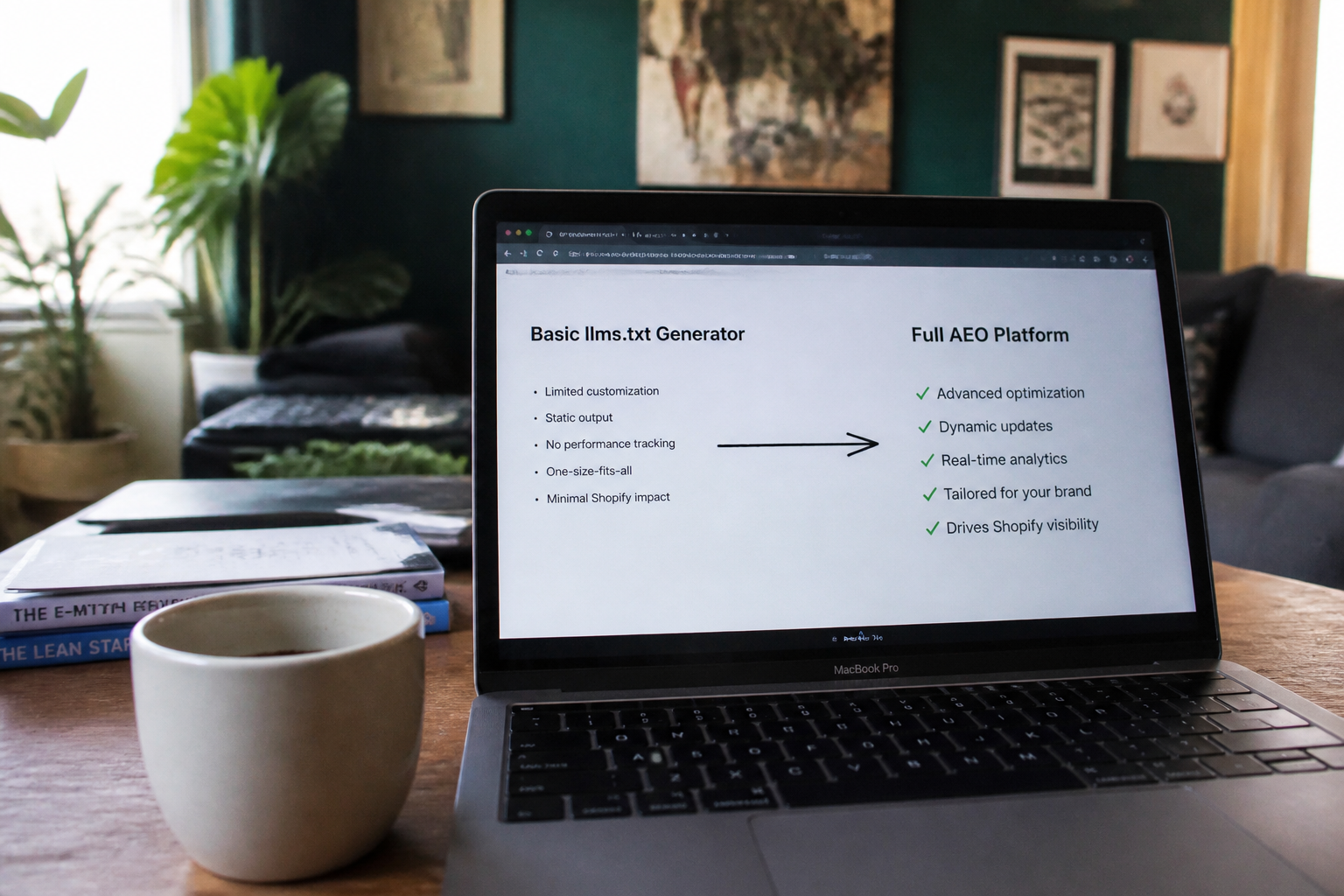
Most basic llms.txt tools simply crawl your Shopify store, gather URLs, and produce a single downloadable file. This works as a quick fix, adding a necessary building block for AI crawlers. But in practice, these basic generators come with substantial limitations:
- No ongoing monitoring or alerts if your site structure changes, products go out of stock, or new collections launch.
- Zero real-time updating—your llms.txt quickly goes stale as your store evolves.
- Little guidance for advanced configurations, such as selectively exposing or hiding content from AI crawlers.
- Lack of insight into how AI models interpret your updates or which actions improve answer engine visibility.
Moreover, as answer engines become more context-aware and intent-driven, they rely increasingly on broader signals than just a static file listing your URLs. Shopify merchants discussing their experiences in reviews make it clear: initial wins from a generator can evaporate without deeper, dynamic optimization. Our recent analysis in Shopify App Store Reviews: What Merchants Say About AEO Apps highlights this evolution in user expectations.
What Makes a Full AEO Platform?
Modern answer engines expect more. A robust AEO platform, such as OtoRank, goes far beyond llms.txt generation by providing an integrated suite of tools designed for ongoing optimization, monitoring, and improvement. Here’s how a full platform differentiates itself:
- Continuous inventory and site monitoring: Automated scans detect new, updated, or removed products and collections, ensuring your exposure to AI models is always current.
- Rich structured data enhancement: Platforms embed and validate schema (such as FAQs, product details, and reviews), making information more accessible to LLMs and featured answer modules.
- Dynamic signal optimization: Actively modifies and suggests improvements for both llms.txt and other relevant signals based on ongoing changes to answer engine best practices.
- Actionable analytics: Surfaces exactly how your site is being crawled and answered by AI, providing reporting and suggestions for improving answer visibility.
- Granular control: Decide which collections, products, or info pages to highlight or suppress for answer engines without technical guesswork.
- Compliance and transparency: Keeps your shop aligned with emerging AI and web standards as they shift, minimizing manual research headaches.
For a deeper checklist of what to look for, we recommend reading What to Look for in a Shopify AEO App Before You Install It.
Real-World Impact: More Than Just Technical SEO
What does this migration mean for your business—beyond technical details? For many Shopify merchants, actionable AEO means more product answers surfaced directly in SGE, higher placement in AI-driven carousels, and improved eligibility for AI-powered product finders or summaries. Consider a merchant who upgraded from a static generator: after the switch, their answers began appearing in Google’s SGE shopping snippets, leading to a measurable uptick in high-intent organic sessions and a 21% increase in conversion rates for featured products.
This isn’t just about traffic—it’s about making it easier for shoppers using new discovery methods to trust and purchase your products.
How To Migrate Thoughtfully—And Avoid Pitfalls
If you’re moving from a basic generator to a comprehensive platform, here’s a process to ensure smooth transition:
- Audit existing signals: Identify which URLs, collections, and products are listed in your current
llms.txt. Note missing or outdated entries. - Install your new AEO platform: Most advanced apps offer onboarding walkthroughs that automatically sync your store’s data and flag key optimization areas.
- Leverage reporting: Use the analytics dashboards to see which answers or snippets are appearing in major AI engines—and which products aren’t yet visible.
- Iterate regularly: As you add or update inventory, let the platform dynamically reflect these changes to answer systems, keeping your site relevant with minimal manual work.
- Connect support channels: If your app offers direct integration with AI/SGE testing tools or support, use them to confirm your setup is being read and interpreted correctly.
Most importantly, allocate time for monthly reviews: the AI landscape evolves quickly, and your platform should help you keep pace. Early adopters are already using this edge to maintain standout visibility in the Shopify App Store, as outlined in our Shopify App Store Positioning hub.
Conclusion: Future-Proof Your Store’s AI Visibility
If your Shopify AEO strategy doesn’t reach beyond generating a single llms.txt file, it’s time to rethink your approach. Full-featured platforms empower you to continuously adapt, track impact, and claim your spot in every relevant AI-powered answer. Don’t settle for static when answer engines are dynamic—migrate thoughtfully, and you’ll be ahead of the curve as AI transforms e-commerce discovery.
Frequently asked questions
What is the difference between a basic llms.txt generator and a full AEO platform?
A basic llms.txt generator just creates a static file listing your store’s URLs for AI crawlers. A full AEO platform continuously monitors your site, dynamically updates signals, embeds structured data, offers analytics, and aligns with evolving AI standards to maximize your store's visibility in answer engines.
Why shouldn’t I rely only on a static llms.txt file for Shopify AEO?
Static files quickly become outdated as your store changes, and offer limited guidance. Answer engines now prioritize fresh, structured data and context—something static files alone can't provide.
How does migrating improve my store’s AI visibility and sales?
By using a full AEO platform, your store’s latest products and FAQs remain visible to AI answer engines. This leads to better placement in shopping snippets, increased high-intent organic traffic, and higher conversion rates.
Is migration to a full AEO platform complex for Shopify merchants?
Most advanced AEO apps are designed for straightforward onboarding, syncing your inventory and recommending optimizations. While an initial audit is helpful, platforms offer automation and support throughout the process.
Where can I learn more about AEO and choosing the right app?
For detailed guides and reviews on the best Shopify AEO strategies and app choices, explore our posts: Shopify App Store Positioning hub, What to Look for in a Shopify AEO App Before You Install It, and the AEO Glossary.
Related reading
Check your own store's AEO score
No login, no email, just a score and what to fix first.