Guide
AI Traffic vs. Organic Search: Reading the Analytics Dashboard
AI answer engines are reshaping how Shopify stores receive traffic. Learn to distinguish and leverage AI-referrals in your analytics for deeper, actionable insights.
AI Traffic vs. Organic Search: How Today’s Analytics Dashboards Are Changing
If you’ve checked your analytics dashboard recently, you may have spotted a new type of traffic cropping up alongside your tried-and-true “organic search.” As AI answer engines like Google’s SGE, Microsoft Copilot, and Perplexity start surfacing Shopify stores directly in their answers, merchants using apps like OtoRank are seeing a new referral: AI traffic. So what does this new channel mean for your performance tracking? And how can you distinguish it from traditional organic search in your analytics?
In this article, we’ll dive deep into the evolving analytics landscape, demystify what’s actually showing up on your dashboard, and outline concrete strategies to make your reporting AI-ready. Let’s cut through the hype and see what matters for your store’s growth.
Unpacking the AI Traffic Surge: What’s Happening?
AI answer engines are transforming how shoppers find products. Instead of clicking ordinary search results, users engage with conversational answers that pull from public web pages. When an LLM-powered tool cites your Shopify store as a source—and users click those links—you get AI-referral traffic.
This new channel behaves differently than traditional SEO traffic. Whereas organic search visitors usually arrive after looking up a specific keyword, AI-referral traffic often comes from users asking broader questions or for recommendations (“What’s the best eco-friendly yoga mat?”). The answer engine selects sources, and if your store is well-optimized for AI, you appear right where shoppers are making purchase decisions.
If you want a primer on what an AI-referred order looks like and how to handle it, check out Your First AI-Referred Order: What It Means and What to Do Next. For now, let’s dig into what this means for your analytics.
How AI Traffic Appears on Analytics Dashboards
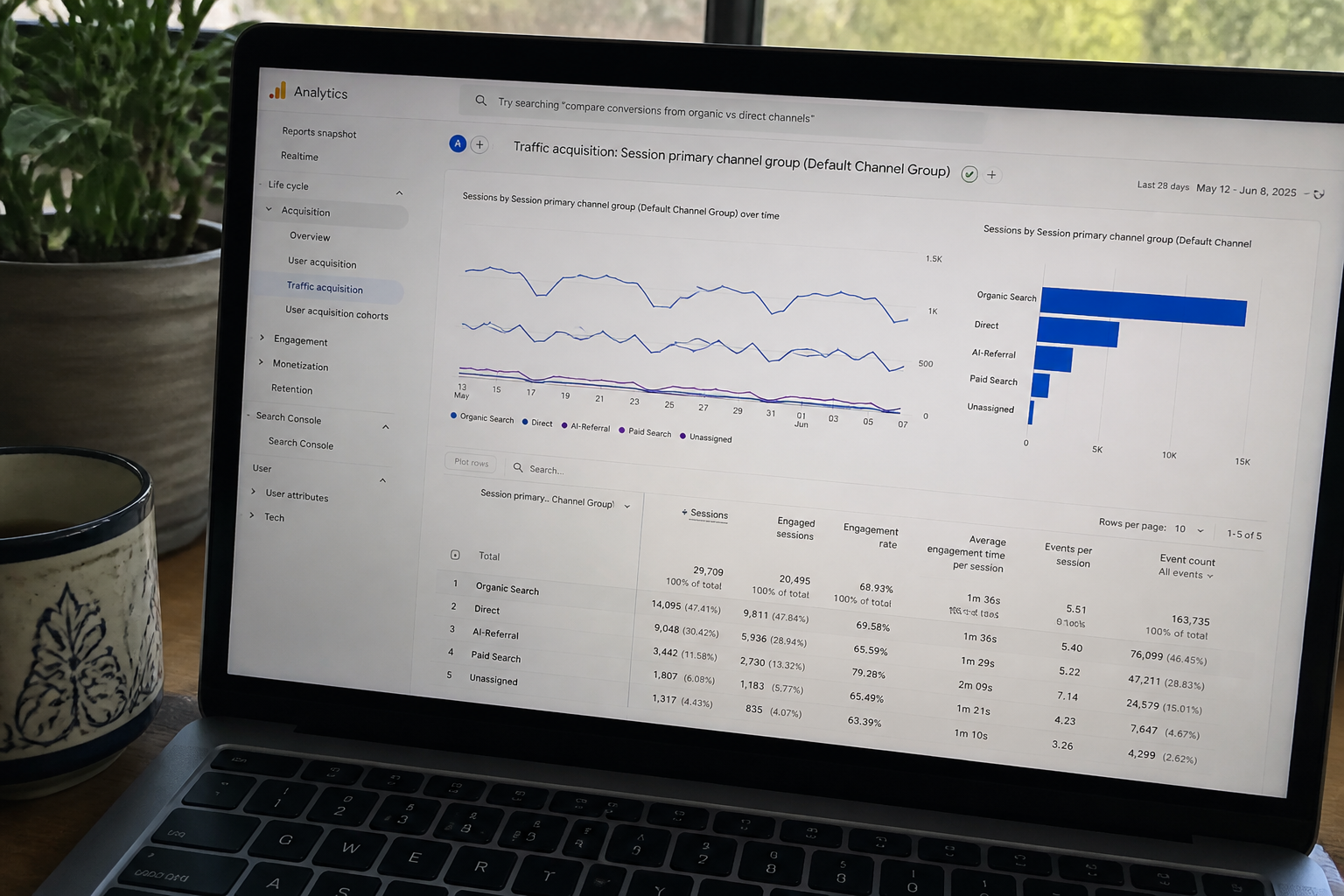
The biggest challenge for most merchants is attribution: recognizing which orders and visits came from AI referrals versus traditional search. Analytics platforms are evolving to help, but the differentiation often comes down to the referral information passed from the AI platform itself—usually in the form of a unique referrer URL or custom UTM parameters.
For example, Shopify analytics may show visits from ‘perplexity.ai’ or ‘bing.com’ with unique LLM identifiers. Using attribution tools specialized for AI-traffic detection (like OtoRank), you can tag sessions as ‘AI Referral’ and visualize trends over time. It’s not just a nice-to-have: as a higher share of discovery shifts to AI answers, classic “organic search” metrics are giving you a smaller slice of the real picture.
This emerging category also complicates historical reporting. If you want to “backfill” older orders to reveal missed AI referrals, see how in Backfilling Historical Orders to Find Hidden AI Referrals.
Why Distinguishing AI vs. Organic Matters for Merchant Insights
At first glance, AI traffic might sound like just another flavor of organic, but treating them the same hides valuable insights. Here’s why segmentation is crucial:
- Customer Intent Differs: AI-driven users often come in at recommendation or comparison stages, not just after searching for a product keyword.
- Performance Optimization: If AI sources drive better (or worse) conversion, you need to know where to double down or pivot your messaging.
- Content Strategy: Answers chosen by LLMs often select for clear, factual, and cited content. Optimizing for AI demands different tactics than classic SEO.
- AI-Referral Metrics Will Become the Norm: As AI answers edge out blue links, distinct attribution is key. The marketing industry is moving this way—learn more on the AI-Referral Attribution hub.
Reading the Dashboard: Real-World Examples
Let’s walk through a concrete scenario. Suppose you sell custom dog collars. In March, your analytics show 200 visits tagged as ‘organic search’ from Google, and 30 visits from a previously unseen source—say, ‘perplexity.ai’ with referrer paths including ‘/answer’ or utm_source=ai-referral.
Upon closer analysis, you notice conversion rates from AI referrals are 2x higher than standard search. Reviewing the session data, you see that the most common AI question cited was “best personalized dog collar for large breeds.” The referring answer featured an excerpt from your product description and linked directly to your product page.
This granular data allows you to:
- Identify which product pages and content are most likely to be pulled by LLMs.
- Assess the revenue specifically attributable to AI answers—not just generic search discovery.
- Inform copy tweaks and structured data elements to boost future inclusion.
For a step-by-step on making your product pages LLM-friendly (without wrestling raw Liquid code), see Theme Injection: Adding LLM References Without Touching Liquid Code.
Preparing for the Analytics Split: Best Practices
- Track AI-Referral Separately: Use tagging tools or UTM conventions to flag this traffic origin and analyze it on its own.
- Monitor Conversion Pathways: Compare post-click behaviors between AI traffic and classic search to tailor your funnel.
- Continuously Update Attributions: New answer engines launch often—periodically refresh your known sources list and review emerging referrer domains.
- Educate the Team: Share these insights across marketing, merchandising, and support to break down internal silos and unify measurement.
Looking Forward: Analytics Fit for the AI Era
The analytics landscape is shifting as fast as AI platforms launch new features. Don’t let AI traffic slip through the cracks or muddy your KPIs: accurate segmentation is foundational, not optional. Shopify merchants who adapt now—by tagging, tracking, and learning from AI referrals—will be best positioned to capture the next wave of e-commerce growth.
Curious about deeper AI-attribution strategies, or ready to surface hidden value in your existing data? Dive deeper with our AI-Referral Attribution hub.
Frequently asked questions
How can I identify AI-referral traffic in my Shopify analytics?
Look for referrer URLs or UTM parameters tied to AI platforms (such as perplexity.ai or Bing Copilot). Specialized attribution tools like OtoRank can tag sessions from these sources for clear reporting.
Why is it important to separate AI traffic from organic search?
Segmentation helps you understand customer intent, optimize campaigns, and accurately measure the ROI of content changes or AI-specific optimizations, as AI users often behave differently from traditional search visitors.
How can I make my Shopify store more visible to AI answer engines?
Focus on clear, fact-rich product descriptions, structured data, and content that is easily cited. For practical guidance, see our post on theme injection for LLM references.
Does AI traffic convert better than organic search?
In many observed cases, AI-referred visitors show higher intent, leading to better conversion rates. However, results depend on product niche and how well your content matches the AI answer criteria.
Related reading
Check your own store's AEO score
No login, no email, just a score and what to fix first.