Guide
Budgeting AI Content Spend Across a 10,000-SKU Store
Budgeting AI content spend across 10,000 SKUs isn’t just about volume—it’s about prioritizing high-ROI products, managing credits efficiently, and knowing when to scale.
Why AI Content Spend Matters for Large Shopify Stores
Running a Shopify store with 10,000 SKUs is both an opportunity and a challenge. On one hand, you’ve built a rich catalog for buyers and search engines; on the other, managing unique, high-quality content for each product is a logistical feat—especially if you’re aiming for AI-driven answer engine optimization (AEO). The rise of AI-generated product descriptions, meta tags, FAQ content, and structured data make it possible to scale, but the costs can add up fast. So, how do you budget AI content spend without wasting resources or compromising quality?
This is where strategic allocation of your content budget—and understanding how credits and billing work—becomes critical. Let’s break down the realities of budgeting for AI content at scale, so you can maximize your ROI while keeping your accounting team happy. For a broad overview of credits, billing and ROI, visit our Credits, Billing & ROI hub.
Understanding AI Content Credits: What Are You Really Paying For?
Most Shopify apps—including OtoRank—operate on a credit system for AI-driven content tasks. Think of credits as units representing specific AI actions, such as generating a description or optimizing a product page for AI answer engines. The more SKUs, the more credits you’ll inevitably burn through. But the devil’s in the details: are you charged for every draft, every edit, or just approved outputs? Does a bulk update consume the same credits as an individual update?
It’s crucial to audit your product content workflow. For example, if you have 10,000 SKUs, but only 3,000 actually need AI-generated descriptions this month, you can tightly control spend by targeting updates. Bulk optimization features may be more credit-efficient in most apps. Similarly, understanding the distinction between draft and published content matters: with OtoRank, credits are only consumed on finalized outputs, not every iteration or revision. For deeper insights on the cost mechanics, check out Shopify Billing API 101: How App Subscriptions Actually Work.
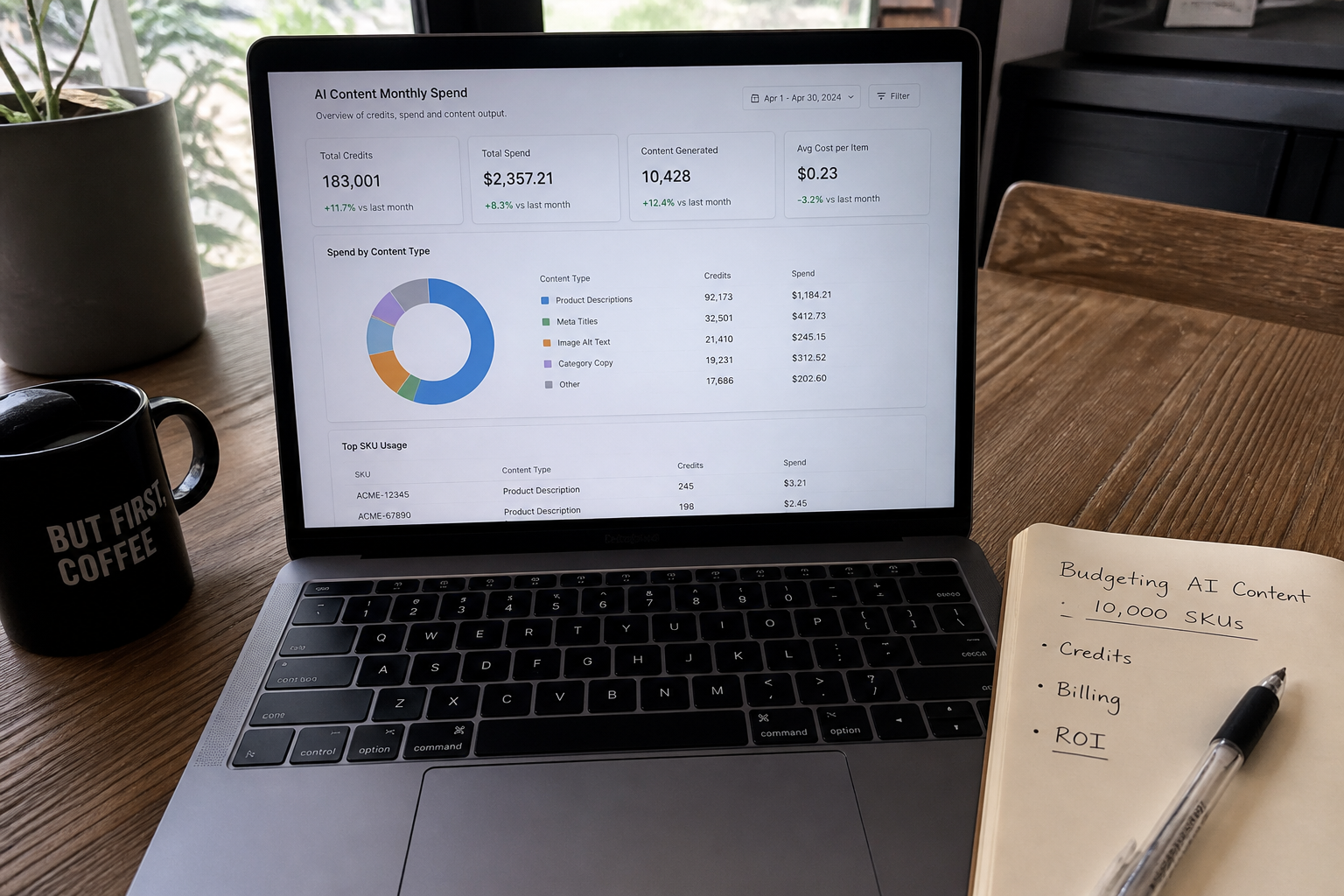
Budgeting for 10,000 SKUs: A Math-Driven Approach
Let’s get granular. If your AI tool charges 1 credit per product description, and your plan includes 5,000 monthly credits, you’ll only cover half your catalog at this tier. But not all SKU content is equal in complexity, competition, or conversion value. Categorizing your catalog into high-traffic/priority and low-traffic/long-tail products allows for smarter resource distribution.
- Tier 1: High-Value SKUs (top 10-20% of products driving most revenue)—Justify investing more credits/AI effort per item here.
- Tier 2: Long-Tail SKUs—Use more basic templates or minimal AI optimization since ROI per item is lower.
- Seasonal or campaign-specific SKUs—Budget one-off AI spend for faster launches or promotions.
This hierarchy ensures you never blow your credit budget trying to optimize everything simultaneously. Instead, you’ll deploy credits where they stand to impact the most revenue, conversion, and AI search visibility.
Don’t Forget Human Review: The Hidden Cost Factor
AI-generated content isn’t a set-it-and-forget-it affair—especially when your brand voice and product accuracy are on the line. Factoring in “human-in-the-loop” time is essential. Even with OtoRank’s advanced AI, merchant review is critical for catching factual errors, compliance issues, or off-brand phrasing. Human review might not consume app credits, but it does impact your budget in the form of labor hours or outsourcing costs. For a deep dive on why this human touch matters, see Human-in-the-Loop: Why Every AI Draft Needs Merchant Review.
Forecasting Upgrades: When to Scale Your AI Content Plan
As your catalog or ambitions grow, your existing AI credits might start to feel limiting. Common signals you’re outgrowing your current plan include needing to refresh content for compliance, frequent launches of new SKUs, or aiming for multilingual/full-site optimization. Monitoring your usage reports is key. Sudden bursts in content spend often sync up with seasonal launches or replatforming projects. If you’re consistently bumping into credit ceilings or manual workarounds, it’s time to reassess. For practical guidance, see When to Upgrade Your AEO Plan: Signals to Watch.
- Track monthly and quarterly credit burn by product segment.
- Set aside contingency credits for urgent campaigns or compliance updates.
- Regularly revisit your SKU prioritization as your catalog matures.
Maximizing ROI: Smarter AI Content Spend in Large Catalogs
The ultimate goal isn’t just filling 10,000 boxes with text. It’s boosting organic AI discovery, improving conversions, and keeping your store competitive—without runaway content costs. By grouping SKUs, tying spend to bottom-line impact, and understanding the nuances of credits and plans, you can efficiently manage your AI content investment. Remember, scaling AI content for a 10,000-SKU store isn’t just about volume—it’s about strategic allocation, robust review processes, and data-driven plan management for real ROI.
Frequently asked questions
How do AI content credits work for large SKU counts?
AI content credits typically represent individual actions, like generating product descriptions or FAQs. For large catalogs, prioritize high-value SKUs and use bulk features to maximize efficiency and avoid overspending.
What’s the best way to allocate AI content budget across 10,000 products?
Segment your catalog into tiers—focus your budget on SKUs with the highest traffic or revenue potential, use basic templates for long-tails, and reserve extra credits for launches or seasonal collections.
Does using more credits always equate to better store performance?
Not necessarily. Smarter allocation—prioritizing high-impact SKUs and ensuring quality through human review—delivers better performance than simply maximizing content volume.
How can I tell when it’s time to upgrade my AI content plan?
Common signals include hitting credit limits, launching new SKUs frequently, or needing sitewide content refreshes. Regularly check usage reports and ROI to determine the need for plan upgrades.
Is human review necessary for AI-generated product content?
Yes, it’s essential. Human review ensures factual accuracy, brand voice consistency, and legal compliance. It’s a hidden cost but pays off in risk mitigation and brand trust.
Related reading
Check your own store's AEO score
No login, no email, just a score and what to fix first.