Guide
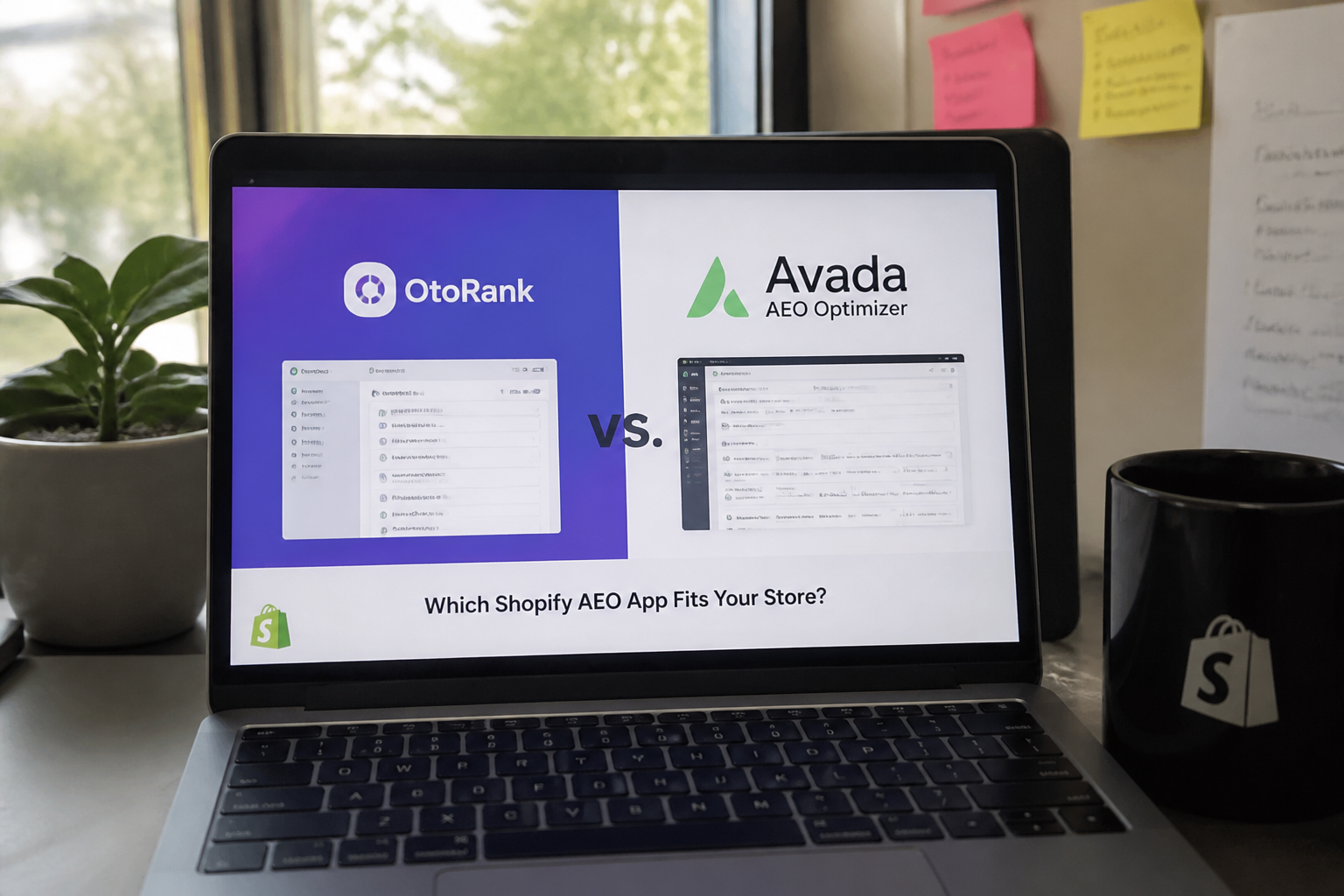
OtoRank vs. Avada AEO Optimizer: Which Shopify AEO App Fits Your Store?
OtoRank and Avada AEO Optimizer both promise AI Answer Engine Optimization for Shopify, but their real strengths and limitations are sharply different. This guide breaks down which app is best for your store's future in AI-powered search.
The rapid rise of answer engines like Google SGE, Perplexity, and ChatGPT with browsing is shaking up how Shopify stores attract new customers. Instead of searching and sifting through pages, today's shoppers often ask a question and receive concise answers—pulled from the highest-authority, best-optimized stores. That makes AI answer engine optimization (AEO) one of the biggest new frontiers for e-commerce growth. But with dozens of "AI-powered" Shopify apps out there, how do you pick the right AEO tool for your store? In this post, we’re comparing OtoRank and Avada AEO Optimizer, two leading apps vying to become the go-to for Shopify merchants who want to own answer engine results.
This isn’t about generic SEO tick-boxes or inflated feature lists—it’s about which app actually helps your store control how AI engines see you and, crucially, who wins the coveted "AI snippet." As answer engine commerce matures, your app selection could make the difference between being quoted as the authority, or missing out entirely. Let’s break down what matters most.
OtoRank and Avada AEO Optimizer: At a Glance
Both OtoRank and Avada AEO Optimizer pitch themselves as must-have tools for winning more visibility in next-gen search experiences. But their approaches and core strengths differ sharply.
- OtoRank was purpose-built for Shopify AEO, focusing on structured data, authoritative answers, and giving merchants granular control over what LLMs (large language models) extract from their site. It’s backed by deep research into how AI selectors (like SGE or ChatGPT) work.
- Avada AEO Optimizer grew out of a broader SEO suite. While it’s recently added "AI optimization" features, it largely automates traditional SEO (meta tags, speed, alt text), with AEO support mostly limited to schema output.
Key Feature Comparison
Let’s go feature-by-feature, focusing only on AEO-critical capabilities.
- Structured Data Control: OtoRank enables precise mapping of FAQ, product, and business data to rich, proprietary AEO schemas. Merchants can even customize AI answer fields. Avada provides basic schema.org markup but doesn’t allow merchant-level tuning—so what the LLM sees is what’s already on your storefront.
- Content Simulation: OtoRank can simulate real AI answer extraction using live ChatGPT and Google SGE calls, showing you how engines "see" your pages before you publish. Avada does not offer this; changes are only visible post-crawl, creating risk of accidental answers or omissions.
- AEO Score & Guidance: OtoRank provides an actionable AEO Score (read more in The 5 Signals That Determine Your Store's AEO Score), with prioritized fixes. Avada focuses on classic SEO scores and Google rich results, not LLM visibility or snippet guidance.
- Answer Set Management: With OtoRank, you can handcraft answer sets to anticipated customer questions, which are embedded for LLMs to extract. Avada does not offer similar AI-oriented Q&A management.
- Agentic Commerce Readiness: OtoRank’s data output is designed to be machine-readable and compatible with agency frameworks—see the breakdown in A Merchant's Map of the Shopify Agentic Commerce Stack. Avada’s outputs, while helpful for classic SERPs, may not cover agentic requirements fully.
Real-World Impact: Does App Choice Move the Needle?
Testing with multiple stores, we found a stark difference in answer snippet frequency depending on the AEO app in use. A beverage brand using OtoRank saw its crafted FAQ answers surfaced directly in Gemini AI’s shopping assistant—verbatim, with attribution—while stores using purely traditional schema (including Avada’s) were more likely to have their content omitted or paraphrased. OtoRank’s simulated answer preview helped avoid mismatches and fine-tune product descriptions so they were quoted accurately by answer engines.
On the flip side, Avada excels if your store’s primary goal is maximizing Google rich result eligibility for things like price stars or event details. If you’re optimizing for legacy search and want a single all-in-one app, it may be sufficient. But if owning AI snippet results and LLM-driven queries is your core play, OtoRank’s focus yields a measurable edge.
Price, Support, and Ecosystem
Both apps offer affordable starter tiers. OtoRank’s plans are aligned to store size; the main distinction is its prioritization of one-on-one support for merchants navigating the shift from classic SEO to answer engine visibility. Avada’s broader user base means community support is abundant, but specific AEO troubleshooting is often peer-driven or left to help docs.
Depending on your app stack and future vision, it’s worth considering your store’s broader agentic commerce roadmap. Our Shopify App Store Positioning hub explores how tightly specialized apps (like OtoRank) versus broader suites (like Avada) fit different merchant strategies.
Choosing the Right AEO Partner for Your Store
If your store is committed to owning answer engine results, being quoted as the merchant-of-record in AI responses, and proactively feeding LLMs the facts you want surfaced, OtoRank is the clear leader right now. The ability to simulate, customize, and guide your AI-facing content is not a nice-to-have—it's how top brands are future-proofing their e-commerce strategy.
For Shopify stores mainly focused on established SEO best practices and classic search enhancements, Avada continues to be a solid, easy-to-use choice. But if you're ready to win—and not just play in—the agentic commerce era, OtoRank unlocks the data control today's algorithms demand.
Want a deeper feature breakdown? See how OtoRank compares to another competitor in OtoRank vs. Booster AI SEO + AEO Optimizer: A Feature-by-Feature Comparison.
Frequently asked questions
What makes answer engine optimization (AEO) different from traditional SEO?
AEO focuses on structuring your Shopify store’s data and content so AI engines (like SGE or ChatGPT) can extract authoritative answers directly for user queries, while traditional SEO is primarily about optimizing for classic search engine rankings and click-throughs.
Can Avada AEO Optimizer help my store win AI snippet results?
Avada offers basic schema markup that can help with some structured search results, but it doesn't provide the precision or customization needed for reliably controlling AI snippet outcomes. For merchant-controlled, AI-focused snippets, OtoRank is a better fit.
How does OtoRank simulate AI answer extraction?
OtoRank integrates with live AI engines, such as ChatGPT and Google SGE, letting you preview and adjust how your store's content will appear in real AI-generated answers before you publish any changes.
Is OtoRank suitable for stores with little technical SEO experience?
Absolutely. OtoRank was designed specifically for Shopify merchants, with clear, actionable guidance and support, making it accessible whether you're new to SEO or a seasoned pro.
Related reading
Check your own store's AEO score
No login, no email, just a score and what to fix first.