Guide
OtoRank vs. Booster AI SEO + AEO Optimizer: A Feature-by-Feature Comparison
Comparing OtoRank and Booster AI SEO + AEO Optimizer reveals key differences in Shopify's evolving AEO landscape, from answer card depth to multi-agent engine support.
Why Compare OtoRank and Booster AI SEO + AEO Optimizer?
The Shopify app marketplace is rapidly evolving as AI answer engines (AEO) and generative search become the new frontier for store visibility. As search engines and shopping assistants pivot towards direct answers and conversational results, Shopify merchants are rethinking their optimization stacks. That’s where apps like OtoRank and Booster AI SEO + AEO Optimizer come into play. Both claim to prepare your store for AI-driven discovery, but their approaches and depth of support differ in crucial ways.
Choosing the right AEO tool isn’t just a matter of ticking the SEO box anymore—it's about positioning your products for rich results in emerging answer engines, multi-agent systems, and shoppable Chatbots. This feature-by-feature comparison will break down how OtoRank stands up to Booster AI SEO + AEO Optimizer, so you can pick the right fit for your growth ambitions.
For a broader strategic view of why AEO matters on Shopify, check out our Shopify App Store Positioning hub, which dives into evolving merchant needs and future trends.
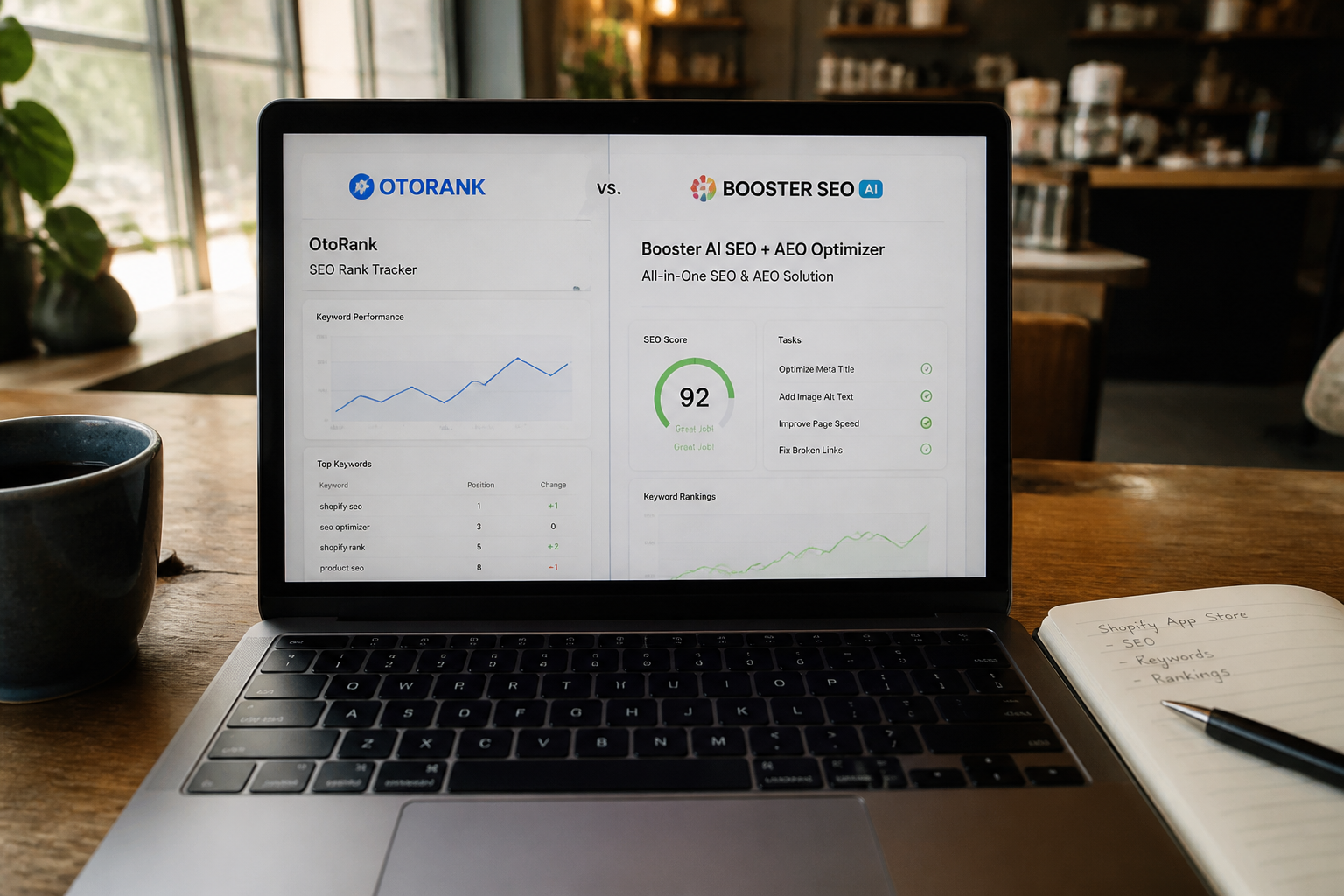
Platform Focus: Breadth vs. Depth
Booster AI SEO + AEO Optimizer is an established player in the Shopify SEO space, recently adding entry-level AEO features like FAQ schema and answer card generation. Booster’s focus is on wide, general SEO coverage—cleaning metadata, auto-generating alt tags, and offering basic tools for Google’s FAQ snippets. It’s familiar and easy for Shopify beginners, but its AEO support seldom goes deeper than supplying simple, repetitive FAQs to Google via schema.
OtoRank, in contrast, is purpose-built for AEO. Where Booster treats AEO as an add-on, OtoRank centers its strategy on optimized answer cards, conversational commerce discovery, and multi-agent protocols. OtoRank natively supports the latest formats, such as Bing Deep Search and the open llms.txt standard. If you’re targeting engines and assistant bots beyond Google—like Bing Copilot, Perplexity, or Shopify’s own semantic search—OtoRank offers a more tailored solution.
AEO Content Generation and Management
Both tools advertise AI-powered content creation, but the outputs and workflows differ. Booster’s bulk generators help fill out SEO basics and simple FAQs, but lack granularity, often repeating generic product descriptions in their answers. Schema is rendered, but rarely customized for each query intent. Editing is possible, but not deeply contextualized for newer answer engine patterns.
OtoRank’s workflow is built around intent-driven answer cards and ongoing iteration. Each product, collection, and FAQ card can be previewed as it would appear in a Chatbot or engine result. OtoRank provides detailed AEO guidance—flagging ambiguous answers, detecting low-coverage products, and enabling you to A/B test new question variants. Crucially, OtoRank structures answers for both classic search and AI agents, using formats recognized in the latest answer engine protocols.
If you're curious how these differences play out across other AEO apps, compare this with our deep dive: OtoRank vs. Avada AEO Optimizer: Which Shopify AEO App Fits Your Store?.
Multi-Agent and Advanced Protocol Support
This is where OtoRank pulls far ahead for merchants focused on the future. Most SEO tools (including Booster) target Google’s existing schema requirements, with little support for emerging multi-agent e-commerce. OtoRank uniquely publishes llms.txt at the root of your Shopify site—an industry protocol, adopted by engines like Bing Deep Search and AI aggregators, that signals which collections and products are open for direct answer indexing. Booster lacks this entirely.
OtoRank also assists with GEO (Generative Engine Optimization), a discipline now advocated by Shopify itself. This goes beyond SEO, ensuring AI bots can interact directly with your catalog. Our previous article Generative Engine Optimization (GEO): Shopify's Own Term for AEO, Explained unpacks the importance for future-proofing your store. Booster’s approach, in contrast, is largely limited to standard FAQ schema, so it may not keep up as engines get smarter.
Analytics and Optimization Insights
Booster provides helpful dashboards for tracking keyword rankings, page speed, and structured data errors. However, it treats AEO as a background process—there’s limited insight into how your FAQs or answers are performing in AI answer boxes or conversational agents.
OtoRank lets you analyze not only classic SEO performance but also AEO metrics: coverage in Bing Deep Search, FAQ click-throughs from Chatbots, card-level impressions, and missing multi-agent fields. This granularity helps you spot exactly where you’re failing to surface in new answer engines, so you can continuously refine your cards for maximum reach.
Ease of Use and Merchant Support
Booster wins on out-of-the-box simplicity for stores just starting with SEO or AEO. Its UI is pared-down, with guided setup for metadata. For merchants who want fast, set-and-forget tools, Booster is familiar. But deeper customization (or debugging why certain FAQs don’t show in answer boxes) can require manual editing or support tickets.
OtoRank’s onboarding is optimized for education and control. Merchants get detailed onboarding flows pointing out why intent-specific answers matter, how to avoid generic filler, and how to optimize each answer for both Google and emergent AI platforms. Hands-on documentation and responsive chat support help stores keep pace with every protocol update—as Shopify, Bing, and other platforms evolve standards, OtoRank rapidly ships compatibility and guidance updates.
For a comparison on protocol agility—especially for multi-agent engines—see our article OtoRank vs. Lumos AI SEO & llms.txt: Choosing an AEO App for Multi-Agent Discovery.
Which Should You Choose?
If your goal is fast implementation of basic SEO and a few standard FAQ snippets, Booster AI SEO + AEO Optimizer is serviceable. However, if you understand that AI-driven discovery is the new battleground for Shopify exposure—and you want granular control, cross-engine coverage, and robust multi-agent support—OtoRank is the clear winner.
The Shopify marketplace will continue to shift toward direct answer, conversational, and agent-driven commerce. Future-proof your store positioning by partnering with a platform at the forefront of these trends. Explore OtoRank to be ready for whatever the next answer engine revolution brings.
Frequently asked questions
Is Booster AI SEO + AEO Optimizer enough for AEO on Shopify?
Booster offers basic AEO features like FAQ schema but lacks advanced support for multi-agent discovery, Bing Deep Search, and intent-driven answer cards. For stores targeting future engines and more granular AEO, OtoRank is better suited.
What is the difference between an AEO-optimized answer card and a regular FAQ schema?
AEO-optimized answer cards are structured and customized specifically for answer engines and conversational search, often including formats like Bing Deep Search or llms.txt, while regular FAQ schema is more generic and targets only Google's snippet box.
Does OtoRank support the latest Shopify and generative engine protocols?
Yes, OtoRank supports generative engine optimization (GEO), publishes llms.txt for multi-agent discovery, and rapidly adapts to protocol changes as Shopify and search engines evolve.
How can I measure if my AEO setup is working?
OtoRank provides analytics for coverage in generative engines like Bing Deep Search, AEO card impressions, and FAQ performance in conversational bots, giving you more actionable insight compared to traditional SEO dashboards.
Where can I learn more about Shopify app positioning for AEO?
Explore our Shopify App Store Positioning hub for strategy deep-dives and evolving best practices tailored to answer engine optimization.
Related reading
Check your own store's AEO score
No login, no email, just a score and what to fix first.