Guide
Why Last-Click Attribution Undercounts AI Influence
Last-click attribution can’t account for the rise of AI recommendations that influence Shopify shoppers before they ever click. Learn how to spot and measure AI's real impact.
Why Last-Click Attribution Leaves AI Visits Out of Sight
Most Shopify merchants rely on last-click attribution to measure where their customers come from. It's a tried-and-true model: you track the user's final click before a purchase, and the source gets all the credit. But in an era where ChatGPT, Perplexity, Google SGE, and other AI answer engines are influencing shoppers long before they land on your site, last-click is letting most of these high-value interactions slip through the cracks.
This matters more each month, as AI-referrals reshape discovery and decision journeys. Shoppers increasingly ask AI for recommendations, compare stores, or get product details—all without ever clicking a traditional ad or link. By the time users make a "last-click," most of their intent and brand preference has already been shaped by AI engines. This new reality exposes a fundamental blind spot in traditional attribution.
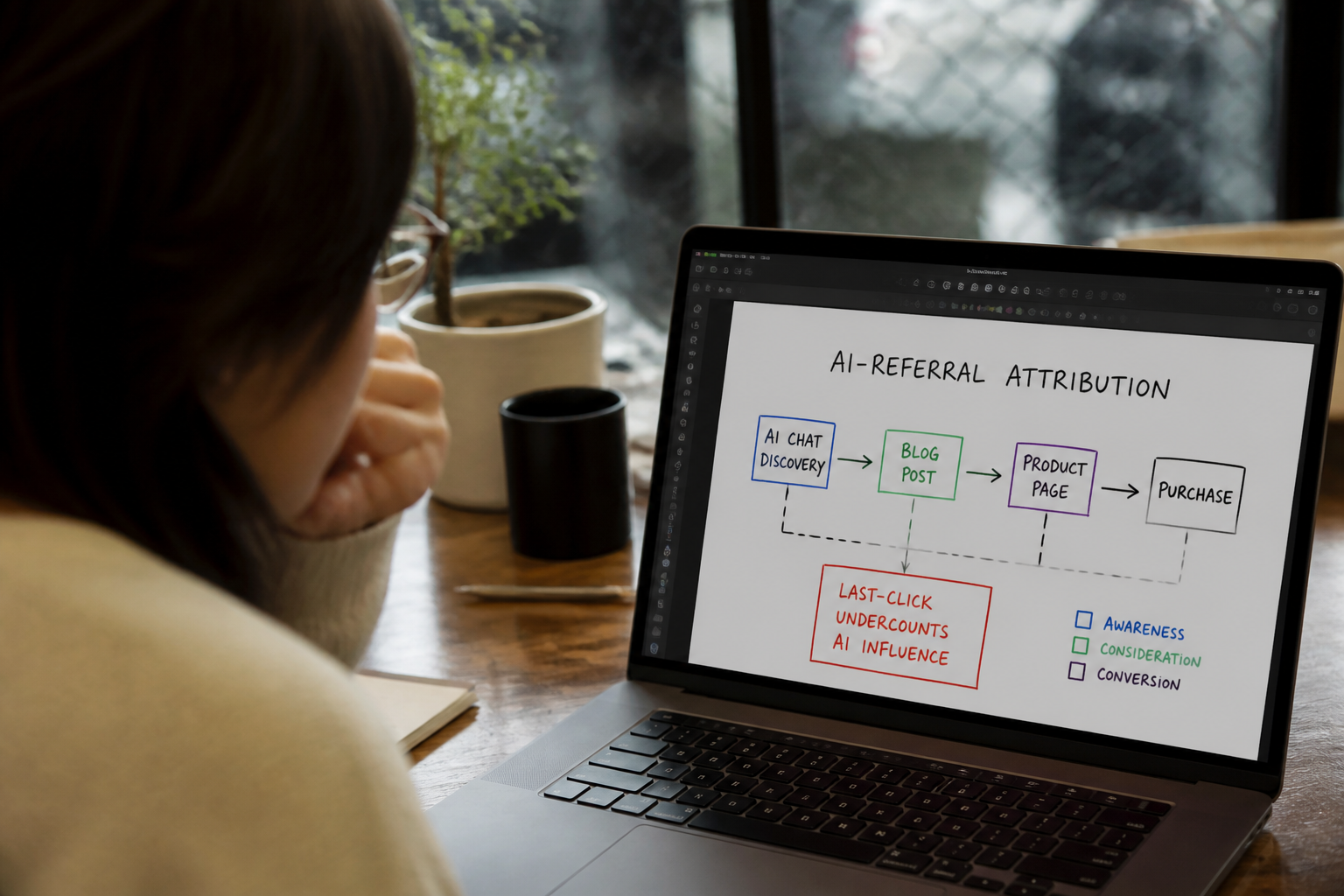
How AI Influences the Funnel—Often Invisibly
Imagine a shopper who types, "What's the most eco-friendly denim brand on Shopify?" into Perplexity or ChatGPT. The AI recommends your store, perhaps summarizing your sustainability practices and highlighting your bestselling jeans. Still, the user doesn't click immediately—they might open a few tabs, compare notes, or revisit an AI the next day for specific product details. Maybe they finally Google your brand directly or type your .com into their browser to make a purchase. In the end, their visit gets attributed to either organic search or direct traffic—not to the AI engine that initially influenced the decision.
This is the heart of the problem: AI answer engines often operate as navigation aids and research companions, not as the literal traffic source that shows up in your analytics dashboard. So when you rely only on last-click attribution, you see a spike in "Direct" or "Organic" traffic—without realizing how many of those visits are actually seeded by AI referrals.
Our deep dive on AI-Referral Attribution covers all the attribution paths that AI can touch, often without leaving a trace in standard reports.
Real-World Example: A Shopify Brand's Missed AI Opportunities
Consider a Shopify skincare brand that appears in both ChatGPT and SGE product roundups for "best serums for sensitive skin." Over several weeks, store analytics show a growing percentage of "Direct" and "Branded Organic" traffic. The team attributes this to seasonal marketing—but misses that a burst of positive AI recommendations is driving curious, ready-to-buy shoppers, primed offsite by conversational AI answers. Without AI-aware attribution, the true source is invisible.
We’ve also seen merchants overhaul their content for AI engines, then see rising revenue but struggle to tie it to a campaign or channel. Unless you set up AI traffic reports for monthly reviews, it’s almost impossible to prove that these "Direct" sales are a downstream effect of AI-driven discovery.
Why Last-Click Can't Track New AI Journeys
Last-click attribution works for simple, linear sales funnels—think "Saw Facebook ad, clicked, bought." But as AI-driven journeys fragment the path to purchase, customers might interact with half a dozen touchpoints before buying, and increasingly, these include AI models serving up store links, product details, and recommendations outside of browser clicks.
The mechanics make it worse: AI-generated answers routinely strip tracking parameters and refer users as "Direct" or "Organic" in web analytics. AI browsers and mobile tools sometimes block referrers altogether. Without extra effort, Shopify store owners using last-click are blind to these influential AI touchpoints, missing optimizations that could accelerate growth or reveal new bestselling content.
This is where AI-specific attribution models and tools are essential. OtoRank and similar solutions help Shopify merchants catch the signals that last-click ignores. By combining traffic pattern detection, custom referral headers, and content monitoring, you can reconstruct the handshake between AI engines and your store, uncovering the real drivers behind "mysterious" sales surges.
What Merchants Can Do: Adapt or Get Left Behind
Taking stock of your analytics is step one. Do you see unexplained jumps in direct or branded search traffic? Do shoppers mention “I saw you recommended by ChatGPT” in post-purchase surveys? These are telltale signs that your attribution is undercounting AI's role. Start building separate traffic reports for AI referrers, and educate your team on spotting these patterns.
If you're worried about integrating new tools or breaking your theme with trackers and scripts, check this guide: Theme Compatibility: Will AEO Tools Work With My Shopify Theme?. Most modern attribution solutions are lightweight and compatible with today’s Shopify setups.
Importantly, last-click isn’t going away—but treating it as your only lens is increasingly risky. The merchants who add dedicated AI-agent referral tracking now will be the ones best positioned to ride the next wave of AI-driven commerce, while competitors play guessing games with their growth.
Conclusion: Seeing AI Influence Means Moving Past Last-Click
Last-click attribution remains valuable for certain campaigns, but relying on it alone will make your analytics blind to Prime-era AI engines that shape demand outside your clickstream. As AI referrals go mainstream and commerce becomes more conversational, your Shopify store's future growth depends on tracing those invisible influences and adapting reporting accordingly.
Merchants who evolve beyond last-click will not only understand their true acquisition sources but will also have unlocked a crucial competitive edge in the age of AI-accelerated ecommerce.
Frequently asked questions
Why does last-click attribution undercount AI referrals?
Last-click attribution only records the final step before purchase, missing upstream influences like AI answer engines that shape shopper decisions but don't leave a direct referral trace in standard analytics.
How can I detect if AI answer engines are driving traffic to my Shopify store?
You may notice unexplained bumps in 'Direct' or 'Branded Organic' traffic, or customers mentioning AI recommendations in surveys. Using AI-specific traffic reports and monitoring tools can provide clearer attribution.
Are AI referral tracking tools compatible with all Shopify themes?
Most modern AEO tracking solutions are designed to be lightweight and work seamlessly with current Shopify themes. For specifics, see the guide on theme compatibility linked in the post.
Can last-click attribution still be useful for my store?
Yes, last-click remains helpful for direct marketing campaigns. However, for understanding full-funnel influence and AI-driven shopper journeys, it's best used alongside AI referral tracking.
Where can I learn more about AI-referral attribution strategies?
Check the comprehensive hub linked in this article for deeper resources and step-by-step guidance on implementing AI-aware attribution for Shopify.
Related reading
Check your own store's AEO score
No login, no email, just a score and what to fix first.